
Blog
Custom Motorcycle Appraisal Documentation: The Build File Checklist Owners Need
Custom motorcycle appraisal documentation is what separates a number an appraiser can defend from one they can't. This checklist covers exactly which build records, receipts, and title paperwork to gather before your insurance, estate, or sale appraisal.
A one-off chopper or a heavily modified sport bike doesn't have a blue book value. When an appraiser sits down to support a value opinion on a custom build, the file they hand back is only as strong as the paperwork the owner hands them first. Custom motorcycle appraisal documentation isn't about hoarding every receipt in a shoebox; it's about assembling specific categories of records that let an appraiser trace value to evidence, not opinion.
Whether you're preparing for an insurance agreed-value policy, an estate valuation, or a pre-sale appraisal, the same core file works for all three. Our custom motorcycle appraisal service is built around reviewing exactly this kind of documentation, and the checklist below reflects what actually moves a report from defensible to bulletproof.
Why Documentation Determines Whether Your Appraisal Holds Up
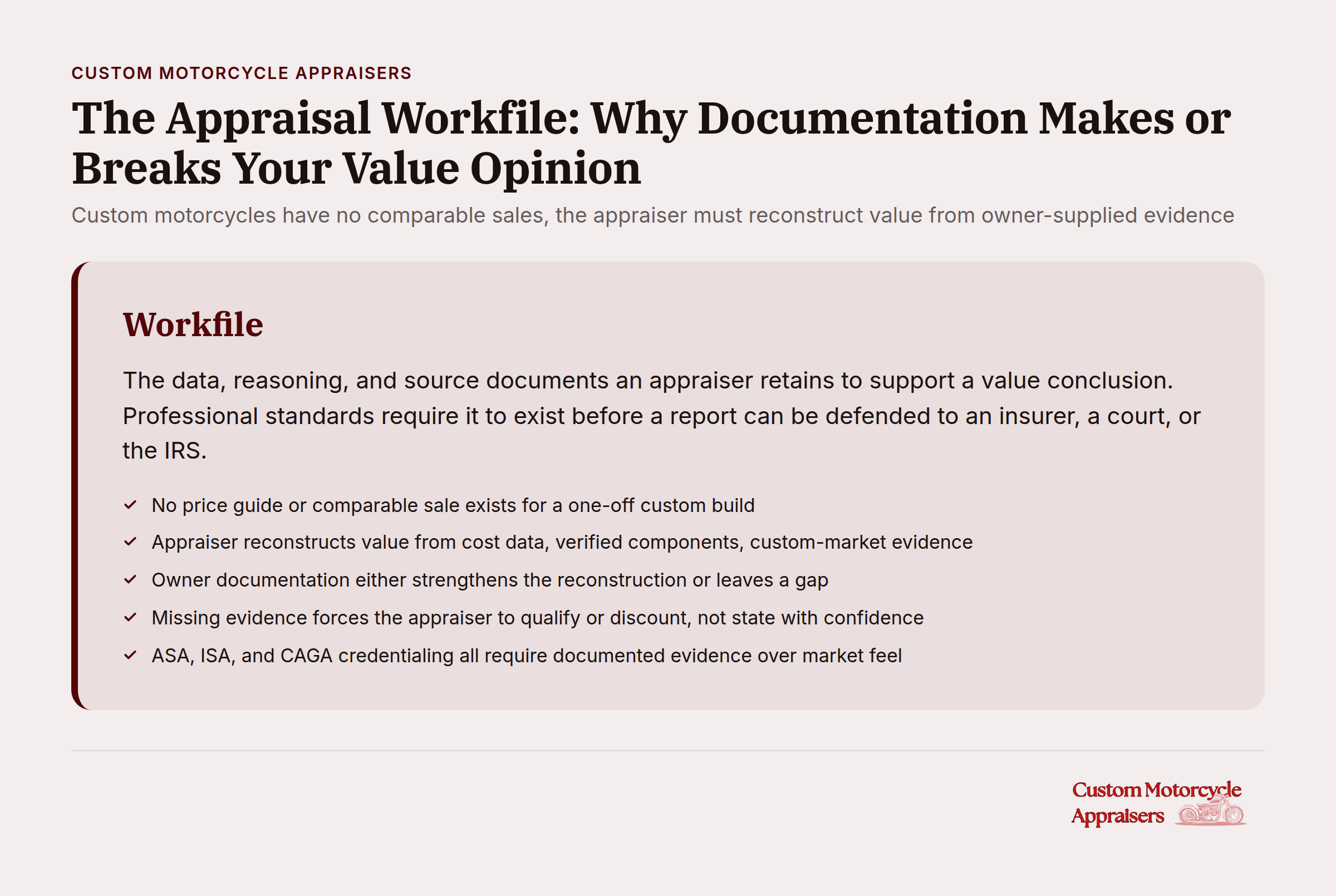
An appraiser's opinion of value is only as credible as the workfile behind it. Personal property appraisers who follow professional standards are required to retain a workfile containing the data, reasoning, and source documents that support their conclusion, and that workfile has to exist before the report can be defended to an insurer, a court, or the IRS.
For a mass-produced motorcycle, an appraiser can lean on published price guides and recent comparable sales. A custom build has none of that. There is no comparable sale for a hand-fabricated frame with a one-off paint scheme and a built engine. That means the appraiser has to reconstruct value from cost data, verified components, and market evidence for similar high-end customs, and every piece of owner-supplied documentation either strengthens that reconstruction or leaves a gap the appraiser has to qualify or discount around.
This matters most in three scenarios: an insurance agreed-value policy (where the insurer wants to see the basis for the stated value before a loss, not after), an estate or gift valuation (where a fiduciary needs a number that survives scrutiny from beneficiaries or the IRS), and a pre-sale appraisal (where a buyer or lender wants proof the asking price isn't invented). If you're weighing whether your custom bike needs stated value coverage instead of standard actual cash value, our guide on agreed value motorcycle insurance walks through why that distinction matters for builds like this.
Appraisers working on custom vehicles typically hold credentials through organizations such as the ASA, ISA, or CAGA, and each of those bodies expects members to support their conclusions with documented evidence rather than a market feel. Better owner documentation doesn't just make the appraiser's job easier; it directly determines how much of the value opinion can be stated with confidence versus qualified as an estimate.
Title, VIN, and Ownership Chain Documentation
Before an appraiser can value a custom motorcycle, they have to confirm what it legally is. That starts with title, VIN, and ownership history, and it gets complicated fast on a bike with a rebuilt or fabricated frame.
Many states require a builder's affidavit and a physical VIN inspection before a reconstructed, assembled, or specially constructed motorcycle can even be titled, and the exact form and process vary by state. Nevada, for example, requires a certificate of inspection or affidavit of construction for rebuilt or specially constructed motorcycles before they can be registered, as outlined in the Nevada DMV's salvage vehicle title guide. Virginia requires a detailed notarized statement describing how the vehicle was constructed, along with photographs of the completed motorcycle, before issuing title on a reconstructed vehicle. Oregon uses a dedicated form for assembled, reconstructed, or replica vehicles that documents where major components came from. Check your own state's DMV for the specific reconstructed-vehicle process, since requirements differ from state to state.
For the appraisal file, gather:
- The current title and registration, plus any prior titles if the bike changed hands during the build.
- Any builder's affidavit, certificate of construction, or VIN inspection form your state required to title the finished motorcycle.
- Photographs of the VIN or frame stamp, matched to the paperwork.
- A written explanation if the VIN was reassigned or the frame was substantially altered from its original configuration.
This section of the file does more than establish legal ownership. It tells the appraiser exactly what they're valuing: a specific, identifiable asset rather than a description that could apply to any similar-looking bike. Without it, an appraiser has no reliable way to confirm the motorcycle in front of them is the one described in prior records, insurance schedules, or a bill of sale.
Build Sheets and Fabrication Invoices
Invoices from every shop involved in the build, fabrication, paint, wiring, tuning, and final assembly, are the backbone of a custom motorcycle appraisal. They establish who did the work, when, and at what cost, which gives the appraiser a documented cost basis to weigh against comparable custom builds.
Keep invoices organized by phase of the build rather than lumped together. A frame fabrication invoice tells a different story than a paint invoice or a tuning invoice, and an appraiser evaluating workmanship quality wants to see labor broken out by specialty. A hand-built frame from a known fabrication shop carries different weight than a frame kit assembled at home, and the invoice is the proof of which one you have.
Pro tip: If a shop invoice bundles parts and labor into one lump sum, ask for an itemized version before your appraisal. A single number tells the appraiser almost nothing about where the value actually sits.
Parts and Component Receipts Tied to the Finished Bike
A parts list is only useful if it can be matched, line by line, to what's actually installed on the motorcycle. Vague receipts ("misc. parts, $2,400") do little for an appraiser trying to substantiate value; itemized receipts with vendor names, dates, part numbers, and descriptions do a great deal.
This is where owners most often fall short. It's easy to keep the big receipts (the engine, the wheels) and lose the smaller ones (custom controls, one-off exhaust work, specialty fasteners) that add up across a build. An appraiser can only credit documented components; anything undocumented gets valued conservatively or excluded entirely, because the appraiser has no basis for confirming it exists or what it cost.
Watch out: Receipts for parts that were purchased but later swapped out or upgraded during the build should be flagged and removed from the file, or clearly marked as superseded. An appraiser matching stale receipts to a bike that no longer has those parts installed is a common source of overstated value claims.
Dyno Sheets and Performance Documentation for Tuned Engines
If the engine has been built, bored, or tuned, dyno sheets, tuning logs, and compression test results give the appraiser objective evidence of performance rather than a builder's claim. A stated horsepower figure with no supporting data is an assertion; a dated dyno printout is evidence.
This documentation matters for two reasons. First, it substantiates a meaningful driver of value on any performance-oriented custom build. Second, it establishes a documented condition and performance baseline as of a specific date, which is exactly the kind of evidence an appraiser needs to support a value opinion tied to that same date. Pair dyno sheets with maintenance and repair records covering the period leading up to the appraisal so the appraiser can see the bike was maintained consistently with its stated performance level.
Progression Photos From Teardown to Completion
Photos taken throughout the build, from a torn-down frame to a finished motorcycle, do something invoices alone cannot: they visually corroborate the paper trail. An appraiser looking at a stack of fabrication invoices and a set of build photos showing that exact frame at each stage has far more confidence than one working from invoices alone.
At minimum, aim to have:
- Photos of the frame or major components before work began, showing original condition.
- Photos at key milestones (frame modification, engine assembly, paint, final build).
- Clear final photos from multiple angles, including close-ups of custom details like paint work, engraving, or fabricated parts.
These photos also tend to satisfy the same documentation states expect for reconstructed-vehicle titling, so keeping a complete photo set serves both the DMV process and the appraisal file at once.
Provenance: Builder Reputation, Show History, and Media Coverage
Beyond parts and labor, a custom motorcycle's value is also shaped by who built it and how it's been recognized. A frame built by a well-known fabrication shop, a bike that won a major show, or a build that was featured in print or online media all carry weight that a parts list alone doesn't capture.
The key is that provenance claims need to be verifiable, not just stated. Gather:
- Printed or digital copies of any magazine features, show programs, or media coverage that name the motorcycle or its builder.
- Award certificates, trophies, or documented show placements, with dates and event names.
- Correspondence or invoices confirming the builder's identity, especially for shops with an established reputation in the custom motorcycle community.
An appraiser can factor builder reputation and show history into a value opinion, but only when it's backed by something they can point to in the workfile. A verbal claim that "a famous builder did the frame" carries no evidentiary weight on its own.
The Documentation Checklist by Category
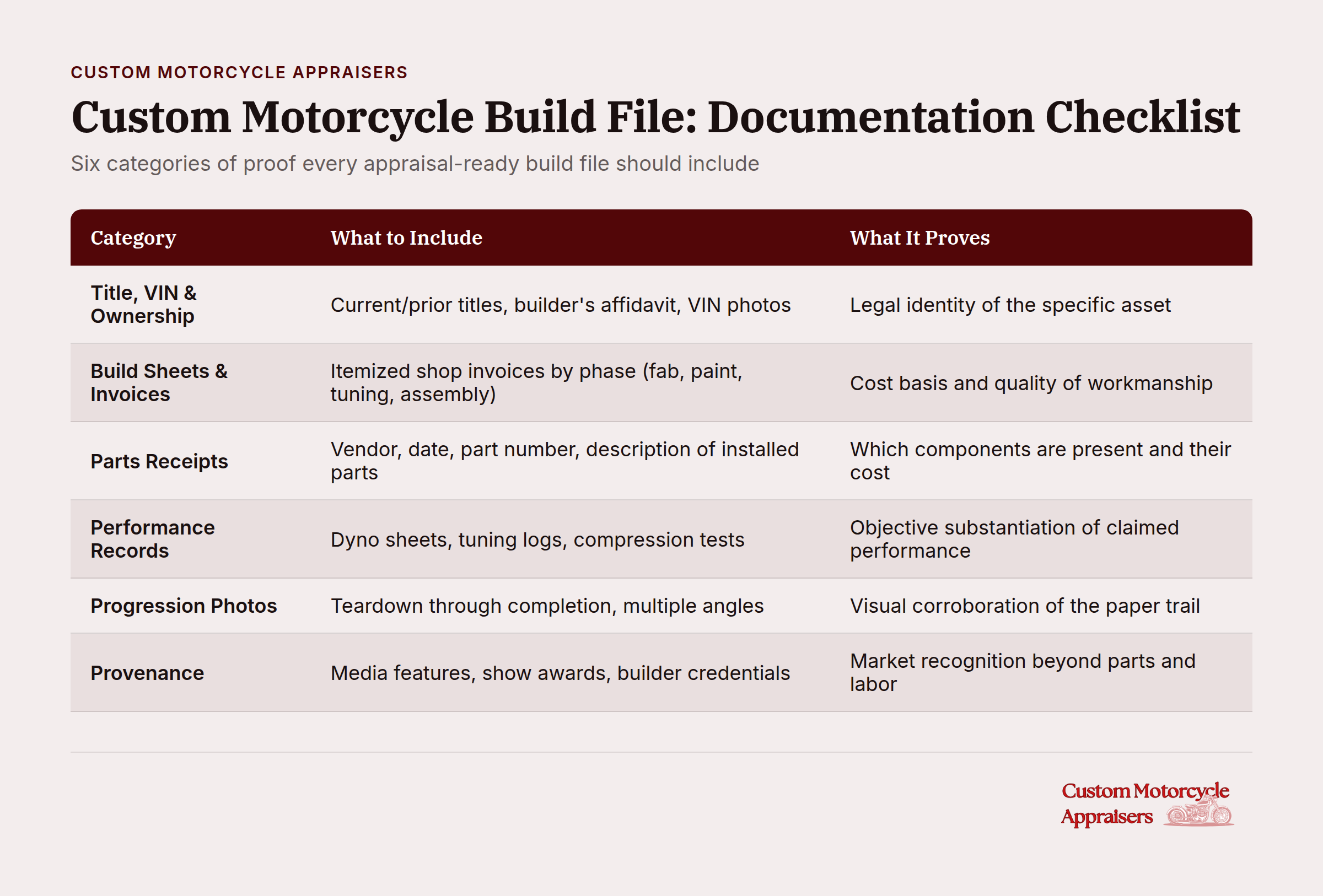
The table below summarizes what to gather and what each category actually proves in the appraisal.
| Documentation Category | What to Include | What It Proves |
|---|---|---|
| Title, VIN, and ownership | Current and prior titles, builder's affidavit, VIN photos | Legal identity of the specific asset being appraised |
| Build sheets and invoices | Itemized shop invoices by phase (fabrication, paint, tuning, assembly) | Cost basis and quality of workmanship |
| Parts receipts | Vendor, date, part number, and description for installed components | Which specific components are present and their cost |
| Performance records | Dyno sheets, tuning logs, compression tests | Objective substantiation of claimed performance |
| Progression photos | Teardown through completion, multiple angles | Visual corroboration of the paper trail |
| Provenance | Media features, show awards, builder credentials | Market recognition beyond parts and labor |
Documenting for an IRS-Qualified Appraisal
If the appraisal will support a charitable donation deduction rather than insurance or estate purposes, the documentation bar gets higher. The IRS Form 8283 instructions require a qualified written appraisal for any non-cash contribution where the claimed deduction exceeds $5,000, and for a donated motorcycle treated as a qualified vehicle, that appraisal is still required unless the deduction is limited to the charity's gross proceeds from selling it. The IRS's guidance on vehicle donations and Publication 526 both set out the substantiation rules that apply on top of the appraisal itself, including the contemporaneous written acknowledgment a donor needs from the receiving charity.
The appraisal itself has to be prepared by a qualified appraiser and dated no more than 60 days before the donation, consistent with IRS Publication 4303's guidance on determining the value of donated property. Every document in the build file described above, title and VIN records, invoices, parts receipts, and provenance, still applies; the IRS appraisal simply adds a stricter timeline and a formal report requirement on top of it. If you're weighing a motorcycle donation, our guide to motorcycle donation appraisals and IRS rules covers the qualified appraisal and Form 8283 process in more depth.
Building the File Before You Need It
The owners who get the strongest appraisals aren't the ones who scramble to reconstruct records after a total loss or an IRS inquiry. They're the ones who kept the file open throughout the build: every invoice, every receipt, every photo, filed as the work happened.
If your build file has gaps, start by pulling whatever records exist now (bank statements, vendor order histories, and shop contact information can often recover receipts you thought were lost) and work backward from there. An appraiser can still produce a credible report with a partial file; it just means being upfront about what's documented and what isn't, so the value opinion reflects the evidence actually available.
Our team reviews build documentation as the first step in every custom motorcycle appraisal, whether it's for an insurance agreed-value policy, an estate filing, or a sale. If you're ready to start gathering records or want a sense of what your file is missing, you can request an appraisal and we'll walk through exactly what's needed for your build.
This article is provided for general informational purposes only and does not constitute legal, tax, or financial advice. Readers should consult a qualified attorney or CPA regarding their specific circumstances.