
Blog
Agreed Value Motorcycle Insurance: Why Custom Bikes Need It Over ACV
Agreed value motorcycle insurance locks in a specific payout before a loss happens, while actual cash value leaves your custom build's worth to a claims adjuster and a generic depreciation table. Here's how the two differ and what it takes to get an insurer to accept your number.
If your custom motorcycle gets totaled, the check you receive depends entirely on which valuation method is written into your policy. Agreed value motorcycle insurance locks in a specific payout amount before anything happens to the bike, while actual cash value (ACV) coverage leaves that number open to a claims adjuster's math after the loss. For a heavily modified or custom-built bike, that gap can run into thousands of dollars, because generic value guides were never built to price custom welds, one-off paint, or a hand-fabricated exhaust. Getting the valuation method right, and backing it with documentation like our custom motorcycle appraisal service, is the single most effective thing a custom bike owner can do before filing a claim.
How Actual Cash Value Works, and Why It Shortchanges Custom Bikes
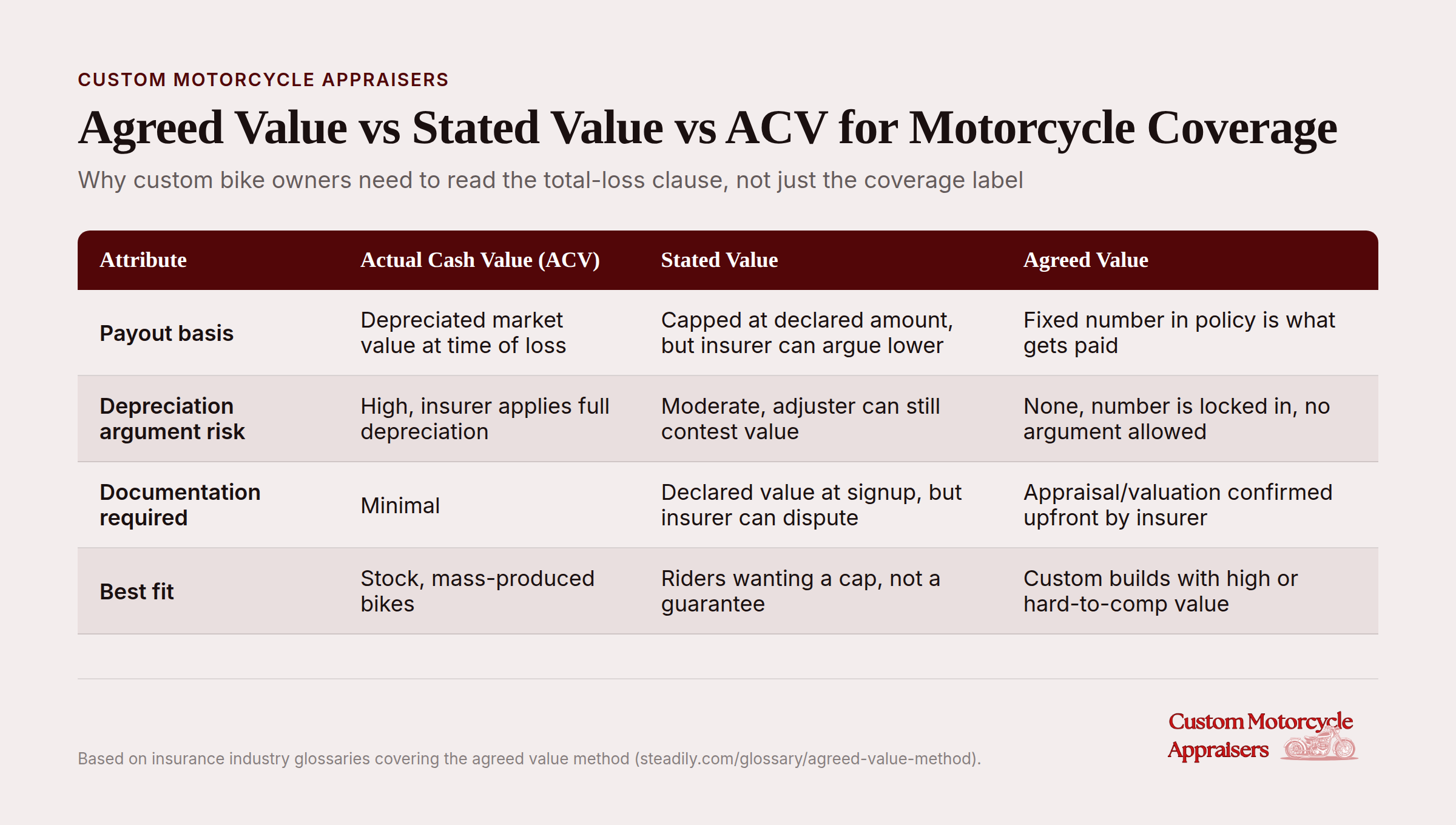
Actual cash value pays the depreciated market value of the motorcycle at the time of the loss, not the amount you spent building it. Insurers calculate ACV only after a claim is filed, using the bike's age, mileage, condition, and comparable sales to arrive at a figure, which means the owner has no certainty about the payout until the claim is already underway, as described in industry explanations of motorcycle insurance value options.
That process works reasonably well for a stock production bike with a clear resale history. It works poorly for a custom build. Standard depreciation tables and value guides like Kelley Blue Book or NADA were built around factory models with known trim levels and mileage curves, not around a frame that has been stretched, a motor that has been rebuilt, or a paint job that took 80 hours of labor. Custom motorcycle guides note that these bikes often have no reliable book value at all, which leaves ACV settlements to an adjuster's judgment call rather than an objective number (see Is KBB the only motorcycle valuation tool?). In practice, that judgment call tends to undervalue rare parts, custom labor, and non-OEM components, because none of those show up in a standard market comparison, as specialty motorcycle insurance guides on custom motorcycle insurance point out.
What Is Agreed Value Motorcycle Insurance?
Agreed value motorcycle insurance is coverage in which the owner and the insurer set a specific dollar figure for the bike in writing before the policy takes effect, and that figure becomes the total-loss payout without further depreciation. The amount typically appears directly on the policy's declarations page and stays fixed for the policy term, subject to renewal updates.
The practical benefit is certainty. If the bike is declared a covered total loss, the insurer pays the agreed amount minus the deductible, with no post-loss argument over mileage, wear, or what a similar bike sold for last month, according to guidance on agreed value vs. actual cash value coverage. That is exactly the protection a custom bike owner needs, since the whole point of agreed value is to capture the full replacement cost of upgrades and modifications rather than whatever a generic guide says the base model is worth.
Agreed Value vs Stated Value: They Are Not the Same Policy
Stated value and agreed value get used almost interchangeably in casual conversation, but they are not the same protection. A stated value policy lets the owner declare a value that caps the maximum payout, yet the insurer can still argue for a lower actual cash value at claim time, which means the owner may end up with less than the stated figure. True agreed value removes that argument entirely: the number written into the policy is the number that gets paid, according to insurance industry glossaries covering the agreed value method.
That distinction matters enormously for a custom bike. A stated value policy might list your build at $22,000, but if the insurer's adjuster pulls a generic comparable and argues the depreciated market value is closer to $14,000, a stated value contract may allow that lower number to win. Before assuming you have agreed value protection, check the actual total-loss clause in the policy language rather than relying on how the coverage is marketed.
Why Insurers Want Documentation to Set an Agreed Value
Insurers do not simply accept whatever number an owner proposes for a custom bike. Underwriters typically ask for supporting evidence before they will commit to an agreed value figure, because they are the ones on the hook for that number in a total loss.
The documentation insurers commonly request includes:
- Photographs of the bike showing its current condition and custom features, taken from multiple angles.
- Receipts for parts, labor, and major upgrades, including aftermarket components and custom fabrication work.
- Build records documenting frame changes, engine work, or other structural modifications.
- Restoration invoices, where relevant, showing the scope and cost of work performed.
A stack of receipts and photos can support an agreed value application, but it puts the insurer in the position of interpreting your paperwork and deciding how much weight to give it. An independent written appraisal solves that problem. It hands the insurer a defensible, market-based opinion of value from a qualified appraiser instead of the owner's own estimate, which is exactly what an underwriter is looking for when reviewing what an insurance appraiser looks for in a custom bike file. That is also why specialty insurers reviewing agreed value applications for custom, classic, or highly modified bikes tend to favor a formal appraisal over a self-assembled documentation packet.
What a Professional Custom Motorcycle Appraisal Should Include
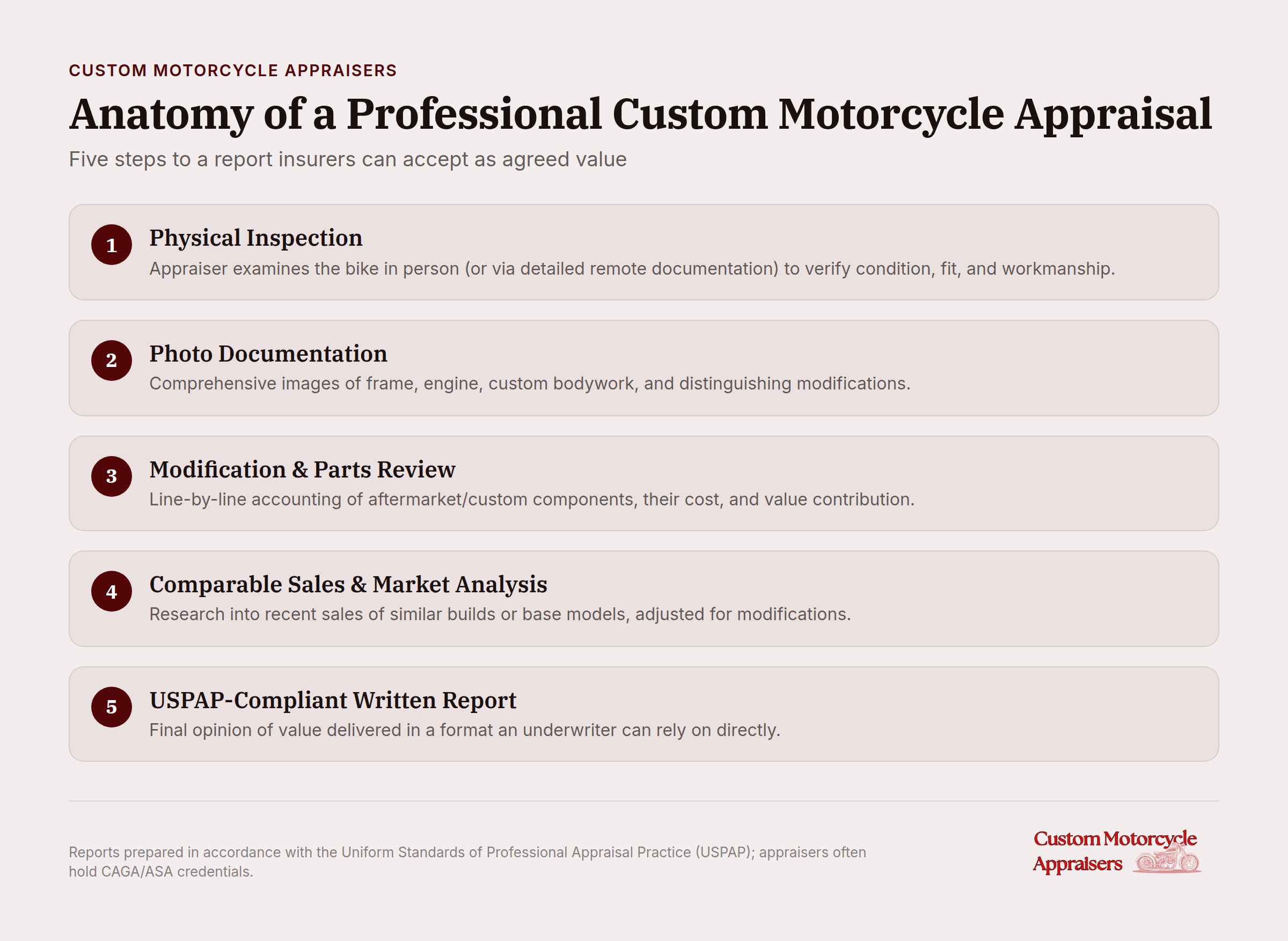
A custom motorcycle appraisal prepared for insurance purposes should give the insurer everything it needs to accept an agreed value without further negotiation. At minimum, a proper report includes:
- A physical inspection. The appraiser examines the bike in person (or through detailed remote documentation, depending on scope) to verify condition, fit, and workmanship rather than taking the owner's description at face value.
- Photo documentation. Comprehensive images of the frame, engine, custom bodywork, and any distinguishing modifications, organized to support the written findings.
- A modification and parts review. A line-by-line accounting of aftermarket and custom components, their cost, and their contribution to the bike's overall value.
- Comparable sales and market analysis. Research into recent sales of similar custom builds or comparable base models, adjusted for the bike's specific modifications.
- A written, USPAP-compliant report. A final opinion of value delivered in a format an insurance underwriter can rely on directly, prepared in accordance with the Uniform Standards of Professional Appraisal Practice.
Appraisers working on custom vehicles commonly hold credentials with organizations such as CAGA and ASA, which train specifically in vehicle valuation methodology rather than general personal property. For custom motorcycles, this type of engagement is quoted as a fixed fee after we scope the assignment, based on the bike's complexity and the depth of documentation involved, never billed hourly.
When Should You Get Your Custom Motorcycle Reappraised?
A custom bike's value is not a one-time number. It should be revisited any time the underlying facts change enough that your existing agreed value no longer reflects the bike sitting in your garage.
The two most common triggers are:
- After major modifications. Adding a new custom paint job, swapping the engine, or investing in significant fabrication work changes the bike's value, and an outdated agreed value figure will not capture that increase if a total loss occurs.
- Before policy renewal. Even without major changes, periodically updating the appraisal (roughly every 2 to 3 years, or sooner for actively modified bikes) keeps the documented value aligned with current market conditions and prevents disputes if the insurer questions an aging figure.
Owners who skip reappraisal after a build project often assume the extra work is automatically reflected in their coverage. It is not. Insurers work from the number on file, and that number only changes when the owner submits updated documentation.
Lock In the Right Number Before You Need It
The difference between agreed value and actual cash value comes down to when the valuation happens: before the loss, in writing, or after the loss, at an adjuster's discretion. For a custom motorcycle, that timing decides whether your payout reflects the bike you actually built or a generic estimate pulled from a value guide that was never designed for it. A current, independent appraisal is what turns an owner's proposed figure into a number an insurer will actually stand behind.
This article is provided for general informational purposes only and does not constitute legal, tax, or financial advice. Readers should consult their insurance provider or a qualified professional regarding their specific policy terms.