
Blog
Can a Motorcycle Appraisal Support an IRS Charitable Donation Deduction?
A motorcycle donation appraisal only supports an IRS deduction above fair market value if the bike falls outside the vehicle gross-proceeds cap. This guide explains the $5,000 appraisal threshold, the four exceptions that let fair market value control, and how to confirm which path applies before you pay for an appraisal.
Donating a motorcycle to charity sounds simple: give the bike, claim its value, move on. The IRS does not see it that way. A motorcycle is classified as a "qualified vehicle" under the tax code, which means a different, stricter set of rules applies than the ones that govern donated furniture, art, or jewelry. Whether a motorcycle donation appraisal actually helps your deduction, or turns out to be wasted money, depends on what the receiving charity does with the bike after you hand over the keys.
This matters more for custom, vintage, and collectible motorcycles than for anything else in the vehicle category, because those are exactly the donations most likely to trigger the exceptions that let fair market value control. Get the sequence backwards, and you could commission a full appraisal on a $30,000 custom build only to have your deduction capped at whatever the charity's auction happened to bring in.
Why the IRS Treats a Donated Motorcycle Differently
A donated motorcycle is not appraised and deducted the same way as a donated painting or a coin collection. Congress created a separate category for vehicles, including cars, boats, and airplanes, under Internal Revenue Code Section 170(f)(12). Motorcycles fall into that category as well.
The practical effect is this: for most vehicle donations, your deduction is limited to the gross proceeds the charity receives when it sells the vehicle, not the fair market value an appraiser might conclude. The charity documents this by issuing Form 1098-C, and that form, not a motorcycle appraisal, becomes the primary piece of substantiation for the deduction in the default scenario. This gross-proceeds cap applies regardless of what a qualified appraisal says the bike is worth , so a donor who assumes an appraisal automatically unlocks fair market value is often mistaken.
The $5,000 Threshold and Form 8283
Outside the vehicle-specific rules, the general noncash contribution threshold still matters. If your claimed deduction for an item, or a group of similar items, is more than $5,000, you must obtain a qualified appraisal signed and dated by a qualified appraiser and complete Section B of Form 8283. Section B requires signatures from you as the donor, from the qualified appraiser, and from the donee organization, and it functions as a summary of the appraisal rather than a replacement for it.
Our custom motorcycle appraisal team prepares reports structured to meet these Section B and qualified-appraiser requirements whenever the fair-market-value path actually applies to a donation. That last clause matters: the appraisal only does useful work if the motorcycle qualifies for one of the exceptions described below.
Watch out: Ordering a full fair-market-value appraisal before confirming which path applies is one of the most common (and expensive) mistakes donors make with motorcycle donations. Confirm the charity's intended use of the bike first.
Four Exceptions Where Fair Market Value Still Controls
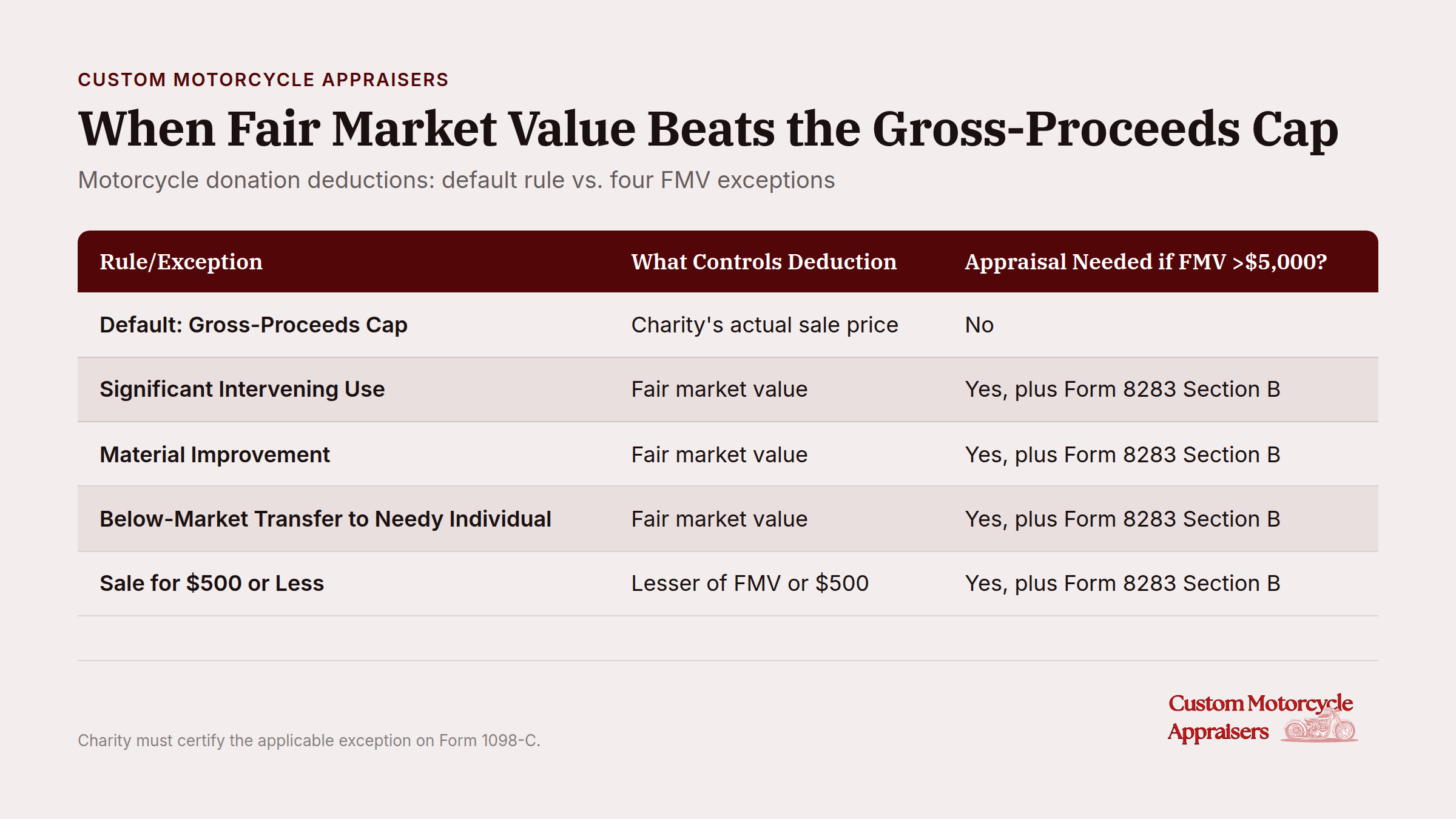
The gross-proceeds cap is the default rule, but it is not the only rule. Fair market value, and therefore a qualified appraisal, still controls the deduction in four specific situations:
- Significant intervening use: The charity uses the motorcycle in a way connected to its charitable purpose before selling it, such as a motorcycle museum displaying a historically significant custom build or a veterans' organization riding the bike in charity events.
- Material improvement: The charity makes a substantial repair or upgrade to the motorcycle before selling it, beyond routine maintenance or cleaning.
- Below-market transfer to a needy individual: The charity sells or gives the motorcycle to a person in need at a price well below fair market value, in direct furtherance of its charitable mission.
- Sale for $500 or less: If the vehicle ultimately sells for $500 or less, the donor may claim the lesser of fair market value or $500, regardless of the gross-proceeds figure.
In each of these four cases, if the claimed fair market value exceeds $5,000, the donor still needs a qualified appraisal and must complete Form 8283 Section B, and the charity must certify the applicable exception on its Form 1098-C. Outside these four situations, the deduction rides on the sale price, not the appraisal.
Why This Distinction Matters Most for Custom and Vintage Motorcycles
A used commuter bike donated to a local charity is almost always going to be auctioned off quickly for operating funds. That donation falls squarely under the gross-proceeds cap: whatever the charity nets from the sale is the ceiling on the deduction, full stop.
A rare Vincent Black Shadow, a one-off custom chopper, or a motorcycle with documented provenance tied to a notable builder or era is a different story. A motorcycle museum accepting that bike for permanent display, or a charity that rides it in fundraising events before eventually selling it, is engaging in significant intervening use. That triggers the fair-market-value exception, and a qualified appraisal becomes the central piece of evidence for the deduction.
Example: A donor contributes a custom-built 1960s motorcycle to a nonprofit transportation museum that puts it on permanent display. Because the museum's use of the bike is directly related to its educational mission and happens before any potential future sale, the donor may claim fair market value, supported by a qualified appraisal, rather than being capped at eventual resale proceeds.
Pro tip: Before commissioning any appraisal, ask the receiving charity in writing what it intends to do with the motorcycle. If the answer is "we'll sell it," the gross-proceeds cap likely applies and a full valuation appraisal may not change your deduction. If the answer involves display, ongoing charitable use, or a below-market transfer to someone in need, the fair-market-value path is probably in play.
Appraisal Timing Rules You Cannot Miss
When the fair-market-value path does apply, the appraisal has to be timed correctly or it will not qualify. The Form 8283 instructions specify that a qualified appraisal must be prepared, signed, and dated no earlier than 60 days before the date of the donation. It also must be received by the donor no later than the due date, including extensions, of the tax return on which the deduction is first claimed. If the deduction is instead claimed on an amended return, the appraisal must be received before that amended return is filed.
Miss either end of that window and the appraisal does not count as "qualified," even if the valuation itself is sound. This is one of the more common technical failure points in vehicle and personal property donations generally, and it is entirely avoidable with basic planning around the donation date.
What Makes a Motorcycle Appraiser "Qualified" Under IRS Rules
Not every experienced motorcycle appraiser meets the IRS definition of a qualified appraiser. The individual generally must hold a recognized appraisal designation or meet specific minimum education and experience requirements, perform appraisals regularly as paid work, and have no disqualifying relationship to the transaction. A qualified appraiser cannot be the donor, the donee organization, or a party who stands to benefit from the outcome of the valuation.
Our appraisers hold credentials with organizations such as the ASA, CAGA, and ISA, and every motorcycle appraisal we prepare is completed in accordance with USPAP and structured to meet IRS Form 8283 requirements when the fair-market-value path applies. For a custom or collectible motorcycle donation appraisal intended for IRS use, our advanced, IRS-qualified reports are quoted as a fixed fee starting at $295, scoped to the specific bike and documentation involved. Engagements are quoted before work begins; we never bill by the hour.
How Fair Market Value Is Determined for a Donated Motorcycle
Fair market value is the price a willing buyer would pay a willing seller, with neither party under any compulsion to act and both having reasonable knowledge of the relevant facts. For a motorcycle, that typically means analyzing comparable sales of similar make, model, year, condition, mileage, and any custom or historically significant modifications.
Dealer retail pricing guides are not treated as conclusive evidence of fair market value for donated vehicles, and neither is a single online listing price. If you are trying to get a sense of what an older or modified bike might be worth before pursuing an appraisal, our guide on what old bikes are worth money walks through the factors that actually move a comparable-sales analysis.
Confirm the Path Before You Commission the Appraisal
A motorcycle donation appraisal is powerful evidence, but only when it applies to the right situation. Before you pay for one, find out whether the receiving charity plans to sell the bike outright or put it to significant charitable use first. That single conversation determines whether your deduction rides on an appraised fair market value or on a sale receipt.
If your donation involves a custom, vintage, or historically significant motorcycle headed for display or ongoing charitable use, request an appraisal before the 60-day window starts running so the report is ready when you need it for your return.
This article is provided for general informational purposes only and does not constitute legal, tax, or financial advice. Readers should consult a qualified attorney or CPA regarding their specific circumstances.