
Blog
A Motorcycle Total Loss Claim Appraisal Case Study: From Lowball to Fair
This motorcycle total loss claim appraisal case study walks through how an independent appraiser challenged a lowball settlement offer by recalculating actual cash value and documenting custom parts. It shows exactly what to request, document, and invoke when your insurer's first number falls short.
The Situation
A rider's custom motorcycle was declared a total loss after an accident. The insurer's initial settlement offer landed around $4,300, a figure that treated the bike as a stock model straight off a dealer lot. The client had put real money and time into custom paint, aftermarket exhaust, upgraded suspension, and other add-ons that made the motorcycle genuinely different from anything a generic valuation tool would recognize.
The client brought in an independent appraiser to review the insurer's number before accepting it. That decision, and the process that followed, is a useful template for any rider facing a similar offer.
The Challenge: How a Standard ACV Offer Overlooks a Custom Bike
An insurer's actual cash value (ACV) offer is supposed to reflect the motorcycle's market value immediately before the loss, based on comparable sales, mileage, condition, and installed equipment. In practice, many initial offers are built from software that pulls generic comparables matched loosely by year, make, and model, without accounting for factory options, dealer-installed upgrades, or aftermarket modifications.
Most states use either a statutory percentage threshold or a total-loss formula to decide whether a vehicle qualifies as a total loss in the first place, and published summaries commonly place that threshold in the roughly 70 to 80 percent range of ACV, though the exact rule depends on the state where the motorcycle is titled and garaged. Once a bike crosses that line, the fight shifts from whether it's totaled to what it was actually worth.
That's where custom motorcycles get shortchanged. Aftermarket parts and modifications can raise a bike's pre-loss market value, but only if the valuation captures them accurately, distinguishing factory equipment from dealer options from labor and installation costs. Our guide on valuing custom parts and modifications in a motorcycle total loss claim covers this distinction in more depth. In this case, the insurer's opposing appraiser had already agreed in principle that certain add-ons should factor into the value; the dispute was over the math and the comparables, not whether custom parts counted at all.
Our Approach: Recalculating ACV and Documenting the Add-Ons
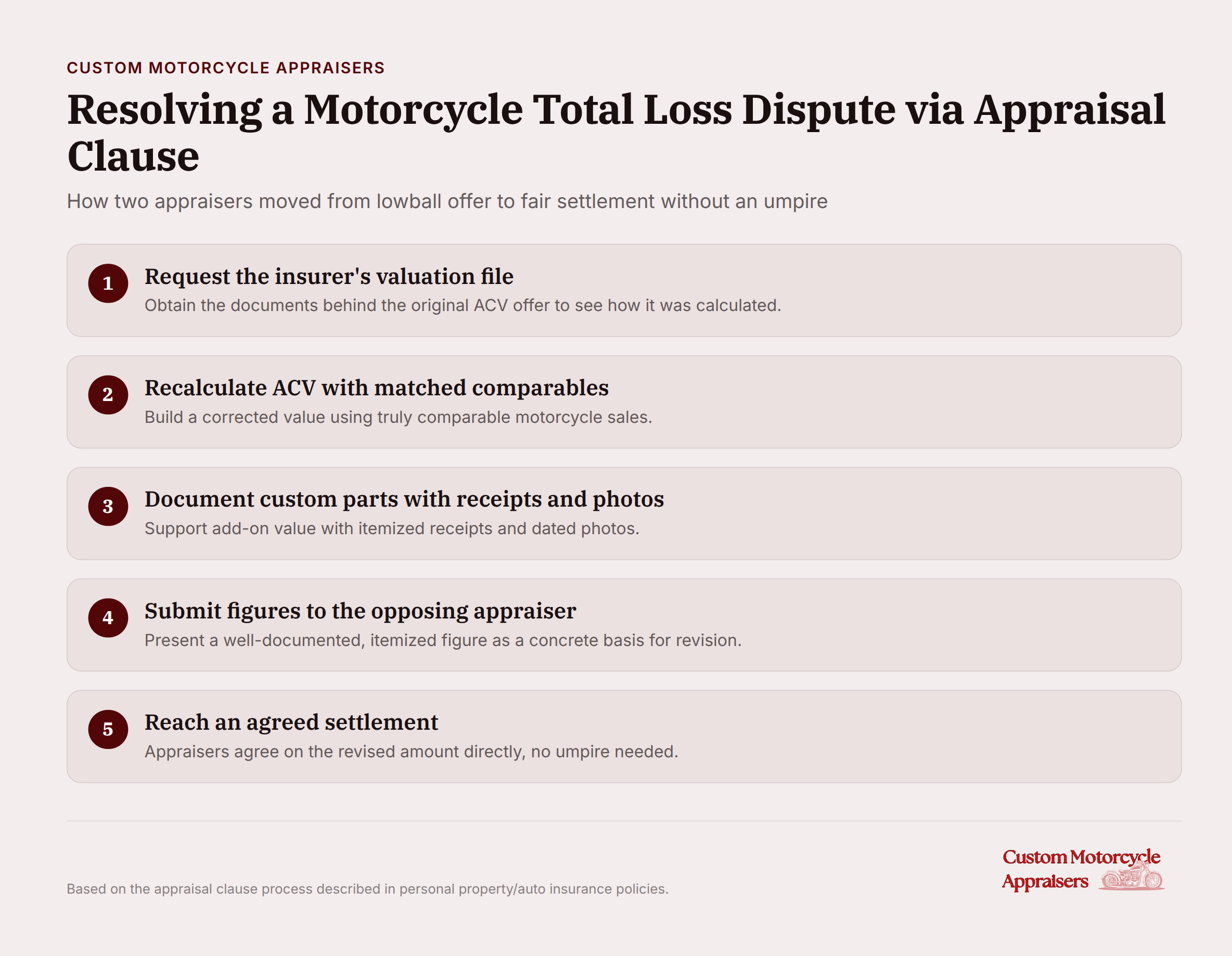
Our appraiser started by requesting the insurer's complete valuation file: the condition and mileage inspection, the comparable vehicles used, and the adjustments applied to reach the initial figure. That file is the foundation of any real negotiation, because a challenge only works when it points to a specific, identifiable error rather than a general sense that the number feels low.
From there, the work had two tracks. First, our appraiser rebuilt the comparable set, matching motorcycles by year, make, model, and category (cruiser, touring, sport, and so on) rather than accepting broader substitutes. Second, our appraiser assembled documentation for each custom add-on: receipts, installation invoices, and dated photographs showing the parts on the bike before the loss. That paper trail is what turns "the bike had upgrades" into a defensible dollar figure.
With the recalculated ACV and the documented add-ons in hand, our appraiser submitted the updated figures directly to the insurer's opposing appraiser, working through the process described in our overview of how the insurance appraisal process works.
How the Appraisal Clause Process Worked
Most personal property and auto policies include an appraisal clause: a built-in dispute resolution process for exactly this kind of disagreement over the amount of loss, separate from disputes over coverage itself. Each side names its own appraiser, and if the two appraisers cannot agree, they select a neutral umpire to settle the remaining difference.
In this case, the two appraisers were able to work through the recalculated ACV and the documented add-ons directly, without needing to escalate to an umpire. That's a common outcome when one side brings a well-documented, itemized figure to the table: it gives the opposing appraiser a concrete basis to revise the number rather than defend the original offer on principle.
The Result
The negotiated settlement came in substantially higher than the insurer's original offer of roughly $4,300. The increase reflected both a corrected ACV based on properly matched comparables and the added value of the custom parts the opposing appraiser agreed belonged in the calculation. Neither side needed to bring in an umpire; the appraisal-clause exchange resolved the gap.
Key Takeaway: What to Do If Your Insurer's Offer Feels Low
A first offer on a totaled motorcycle is a starting point, not a final answer. If the number ignores your bike's condition, mileage, or customization, you generally have the right to push back, and the policy's appraisal clause exists precisely for this situation.
A few concrete steps make the difference between accepting a lowball number and getting it corrected:
- Request the insurer's full valuation file, including the comparable vehicles used and any adjustments applied. You cannot challenge a number you cannot see.
- Document every custom part with receipts, invoices, and dated photographs taken before the loss. Verbal descriptions of upgrades rarely move an adjuster; paperwork does.
- Check your state's notice deadlines. Some states impose short windows for disputing a settlement. New Jersey, for example, allows a policyholder to reopen a total-loss file by giving written notice within 30 calendar days of receiving the claim draft if a comparable vehicle cannot actually be purchased at the stated value. Other states set their own approved valuation methods and timelines, so the applicable rule depends on where the motorcycle is titled.
- Invoke the appraisal clause in writing if your policy has one, and bring your own qualified appraiser rather than negotiating the number alone.
Owners who want to avoid this fight altogether should also look at how their policy values a customized bike in the first place. Our breakdown of agreed value motorcycle insurance for custom bikes explains why ACV coverage is a poor fit for a heavily modified machine, and what to ask for instead before the next renewal.
If you're facing a total loss offer that doesn't reflect your bike's real condition or customization, our team can review the insurer's file, recalculate the value, and work the appraisal-clause process on your behalf. Request an appraisal to get started.
This article is provided for general informational purposes only and does not constitute legal, tax, or financial advice. Readers should consult a qualified attorney regarding their specific claim and state's insurance regulations.