
Blog
Motorcycle Appraisal for Estate and Probate: How Executors Should Value a Bike
A motorcycle appraisal for estate purposes hinges on one number: fair market value as of the date of death, not today's listing price. This guide explains when the IRS requires a written appraisal, when an informal valuation is enough, and what to gather before the appraiser arrives.
When a motorcycle owner dies, someone (usually the executor, sometimes a grieving family member) has to answer a deceptively simple question: what is this bike worth? Get the number wrong and the consequences run in both directions. Value it too low and the estate risks a challenge from the IRS or from other heirs. Value it too high and the estate overpays tax or one heir gets shortchanged in the split. This guide covers when a formal, written motorcycle appraisal for estate purposes is actually required, when a simpler valuation will hold up, and why the number that matters is always tied to a single date: the date of death.
What Is "Fair Market Value" for a Motorcycle in an Estate?
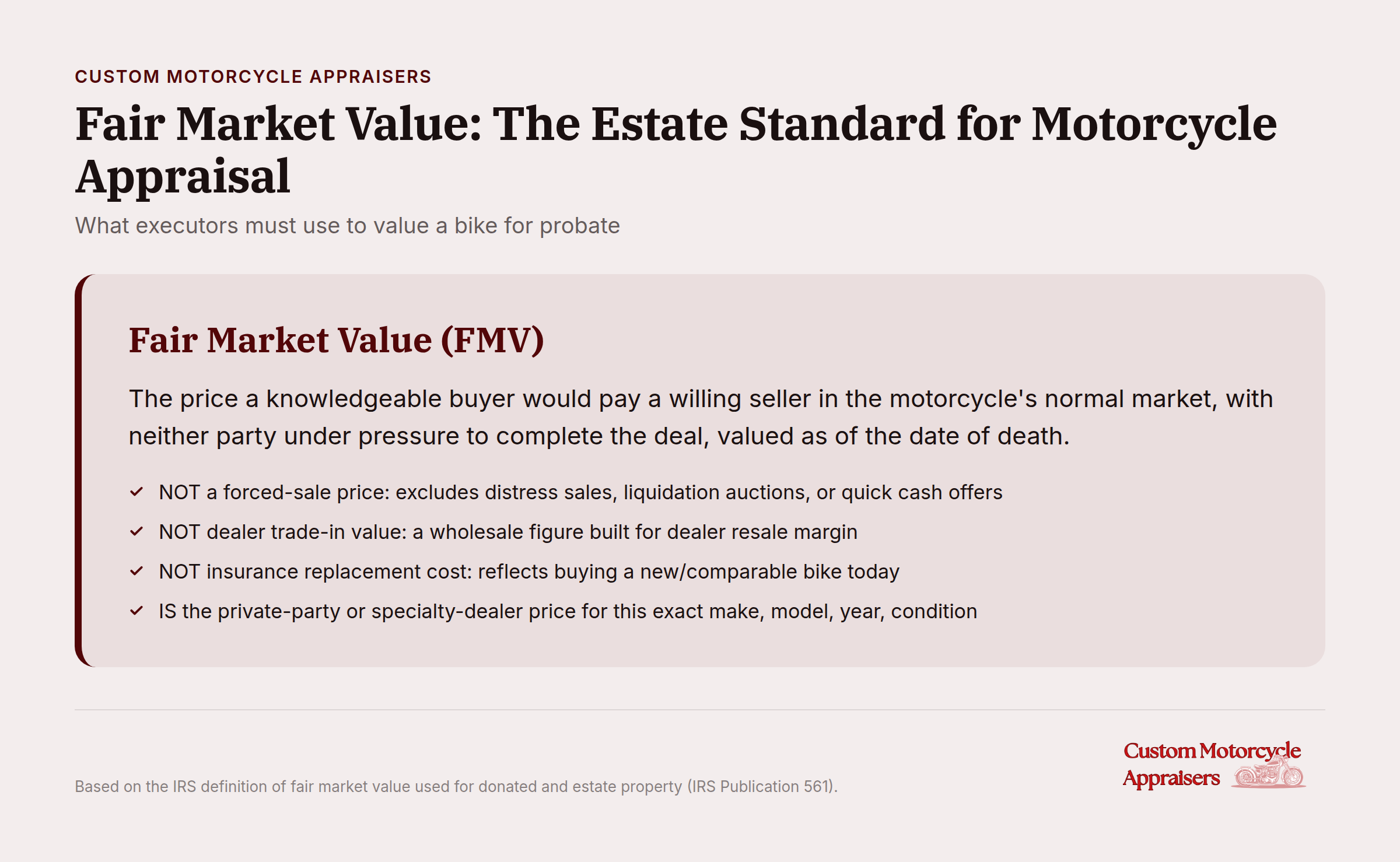
Fair market value is the price a knowledgeable buyer would pay a willing seller in the market where that motorcycle is normally sold, with neither party under pressure to complete the deal. This is the same definition the IRS uses for valuing donated and estate property, and it explicitly excludes forced-sale prices, meaning a distress sale, an auction liquidation, or a quick cash offer to an estate-clearing service does not set the legal value.
For a motorcycle, that market is typically the private-party or specialty-dealer market for machines of its make, model, year, and condition, not a dealer's trade-in offer and not an insurance company's replacement-cost figure. Trade-in values are wholesale numbers built for a dealer's resale margin. Replacement cost reflects what it would take to buy a similar new or comparable bike today. Neither one answers the question the estate actually has to answer, which is what this specific motorcycle, in its actual condition, would fetch between a private buyer and seller on the date the owner died.
When Does the IRS Require a Written Appraisal for a Motorcycle?
A qualified written appraisal is required for federal estate tax reporting whenever an item, or a collection of similar items, is valued at more than $3,000. Below that threshold, the executor can generally rely on a good-faith estimate; above it, the regulations call for a written appraisal by a qualified appraiser, made under oath, along with a statement of that appraiser's qualifications. This threshold applies to motorcycles the same way it applies to jewelry, art, or firearms: it is not about how much the family cares about the bike, it is about the dollar figure it contributes to the gross estate.
Most custom, vintage, or well-optioned motorcycles clear $3,000 without much argument, which means most motorcycle estates that need to file IRS Form 706 will need a real appraisal, not a printout from a pricing website. Our custom motorcycle appraisal service prepares these reports specifically for that purpose: a USPAP-compliant valuation with the appraiser's credentials, methodology, and reasoning documented, so the estate has something defensible if the IRS or another heir questions the number.
Watch out: A screenshot of a listing price, a friend's guess, or a dealer's verbal quote does not satisfy the written appraisal requirement once an item crosses the $3,000 line. If the estate later needs to substantiate that figure, an undocumented number is a weak point auditors and opposing counsel both know to probe.
Informal Valuation vs. Formal Written Appraisal
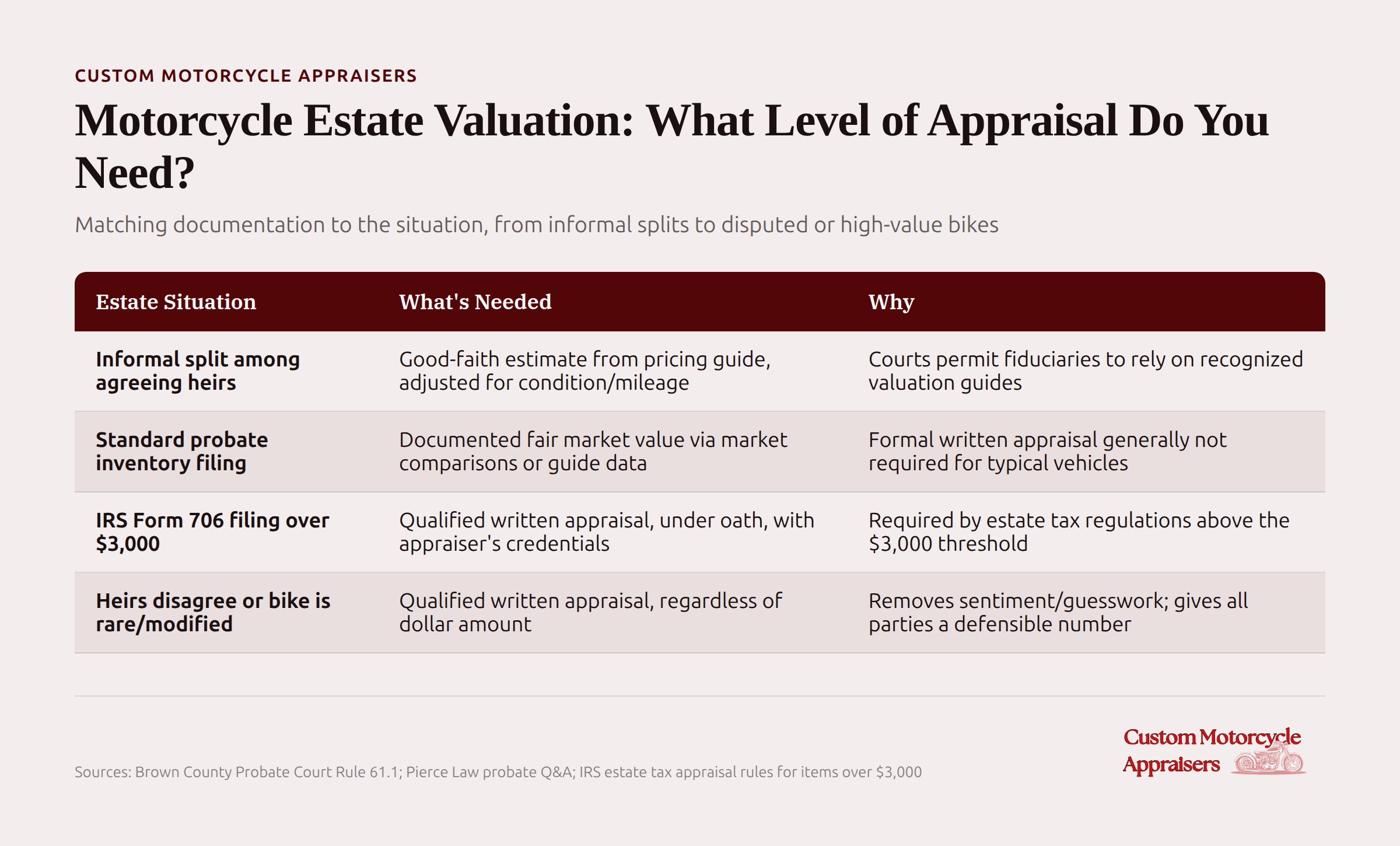
Not every motorcycle in an estate needs the same level of documentation. The right approach depends on what the value is being used for and how much is at stake.
| Situation | What's typically needed | Why |
|---|---|---|
| Dividing personal effects informally among heirs who agree | A good-faith estimate from a recognized pricing guide, adjusted for condition and mileage | Courts in some jurisdictions explicitly permit fiduciaries to rely on nationally recognized valuation guides for motor vehicles |
| Filing the probate inventory for a standard motorcycle | A documented, good-faith fair market value supported by market comparisons or guide data | Probate guidance generally does not require a formal written appraisal for typical vehicles when reasonable estimates are well supported |
| Reporting the motorcycle on IRS Form 706 above $3,000 | A qualified written appraisal, under oath, with the appraiser's credentials stated | Required by the estate tax regulations for items or collections over the $3,000 threshold |
| Heirs disagree on the split, or the bike is a rare or heavily modified build | A qualified written appraisal, regardless of dollar amount | Removes sentiment and guesswork; gives every party the same defensible number |
Why Date-of-Death Value, Not Listing Price or Replacement Cost
The value that goes on the estate tax return and the probate inventory is the fair market value on the date of death, full stop. Not what the owner paid for it, not what a similar bike is listed for today, and not what it would cost to buy a brand-new replacement.
This matters because motorcycle values move. A model that was hard to find two years ago may be common today, and a bike with mounting mileage loses value every season it sits unused. General pricing guides such as Kelley Blue Book's motorcycle tool illustrate the distinction well: they separate trade-in value from private-party value precisely because those numbers serve different purposes, and neither one is automatically the fair market value an estate needs. An appraiser working a date-of-death valuation has to reconstruct what the market looked like on that specific day, not the day the family finally gets around to dealing with the bike.
Example: A collector dies in March owning a limited-production custom build. By the time the estate settles the inventory in August, similar builds are listing 15% higher due to a surge in collector interest. The estate still reports the March value, supported by contemporaneous market data, not the August price.
What Affects a Motorcycle's Fair Market Value
For a standard production motorcycle, condition and mileage do most of the work. For a custom or collectible bike, several other factors carry real weight:
- Condition: Mechanical soundness, paint and finish quality, and any deferred maintenance all move the number up or down.
- Mileage: Lower mileage generally supports a higher value, but originality can sometimes outweigh mileage on collectible models.
- Originality: Matching-numbers engines, original paint, and factory-correct components typically command a premium over a bike that has been heavily parted out and reassembled.
- Modifications: Custom work can add value when it is high-quality and well-documented, or subtract value when it strips away originality collectors want.
- Rarity: Limited production runs, discontinued models, and one-off builds require market research beyond a standard pricing guide.
Even government valuation guidance recognizes that motorcycle values need adjustment beyond a flat number. One state's personal property tax guide instructs assessors to pull suggested list values from recognized motorcycle appraisal guides and apply a standard depreciation factor, which underscores that even official bodies treat published guide prices as a starting point, not a finished valuation.
Pro tip: For anything beyond a common production model, don't rely on a single guide number. A qualified appraiser will cross-reference recent comparable sales, not just list prices, since asking prices and closed sale prices for custom and collectible bikes can diverge significantly.
The Alternate Valuation Date Election
Executors have one notable option worth knowing about: IRC Section 2032 allows an estate to elect to value all estate assets, including a motorcycle, six months after the date of death instead of on the date of death itself. This election is only available if it reduces both the gross estate value and the estate tax liability, and it applies to the entire estate, not to individual items picked one by one. If a motorcycle's value (or the broader estate) is expected to decline in the months after death, this is worth raising with the estate's attorney or CPA before the appraisal is finalized.
What to Gather Before the Appraisal: A Step-by-Step Checklist
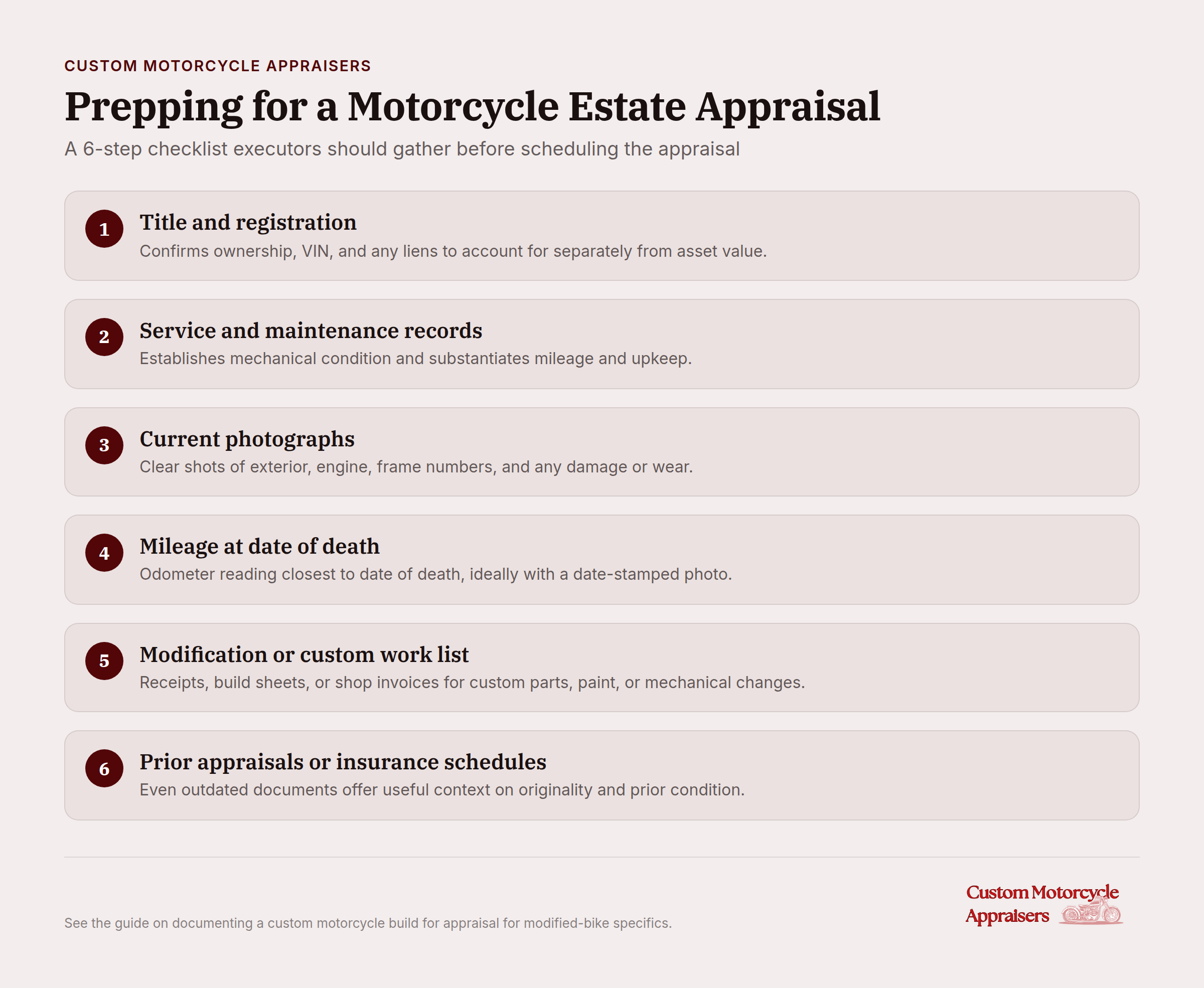
An appraiser can move faster, and produce a more defensible report, when the family arrives with documentation already assembled. Before scheduling a motorcycle appraisal for estate purposes, gather the following:
- Title and registration. Confirms ownership, VIN, and any liens the estate needs to account for separately from the asset's value.
- Service and maintenance records. Establishes mechanical condition and helps substantiate mileage and upkeep.
- Current photographs. Clear images of the exterior, engine, frame numbers, and any damage or wear give the appraiser a documented starting point.
- Mileage at date of death. The odometer reading closest to the date of death, ideally with a date-stamped photo.
- List of modifications or custom work. Include receipts, build sheets, or shop invoices for any custom parts, paint, or mechanical changes.
- Any prior appraisals or insurance schedules. Even outdated documents give the appraiser useful historical context on originality and prior condition.
For custom and heavily modified builds specifically, our guide on documenting a custom motorcycle build for appraisal walks through what a build file should include so the appraiser can properly value the modifications rather than guessing at their cost or quality.
Getting the Value Right the First Time
A motorcycle appraisal for estate purposes only has to be defensible once, but it has to be right the first time. When the estate needs to file Form 706, when heirs disagree on the split, or when the bike is a rare or heavily customized build, a qualified written appraisal grounded in date-of-death fair market value protects the estate and every heir attached to it. For everyday inventory purposes on a standard production bike, a well-documented, good-faith estimate from a recognized pricing guide is often sufficient. When in doubt about which situation applies, err toward the formal appraisal; it costs less than an IRS inquiry or a probate dispute.
Our appraisers prepare fixed-fee, USPAP-compliant motorcycle appraisals for estate and probate matters after scoping the assignment: the number of motorcycles involved, whether the report needs to be IRS-qualified, and the depth of research a rare or modified build requires. If your family is settling an estate that includes a motorcycle, request an appraisal and we'll scope the report to exactly what the estate needs.
This article is provided for general informational purposes only and does not constitute legal, tax, or financial advice. Readers should consult a qualified attorney or CPA regarding their specific circumstances.