
Blog
Motorcycle Appraisal for Divorce: Protecting Custom Bike Value in Settlement Negotiations
A motorcycle appraisal for divorce gives spouses an independent, documented value instead of a book-value guess, which matters most when one side owns a custom or vintage bike. This guide explains why NADA and Kelley Blue Book figures miss custom work and how a USPAP-compliant appraisal strengthens your position at the negotiating table.
When a marriage ends and a motorcycle sits in the garage, the question of "what is it worth" rarely has a simple answer. A stock commuter bike might be easy enough to price from a valuation guide. A custom build with years of aftermarket parts, a frame-off restoration, or a documented ownership history is a different problem entirely, and it's exactly the kind of asset that gets lowballed or over-claimed during property division.
A motorcycle appraisal for divorce exists to settle that question with evidence rather than guesswork. It doesn't decide whether the bike is marital or separate property, and it doesn't decide how a court will divide the estate; state law and the judge handle that. What it does is give both spouses, and their attorneys, a defensible number to negotiate around. Our custom motorcycle appraisal team prepares exactly this kind of report for divorcing couples and their counsel.
Why Book Value Fails Custom and Vintage Motorcycles
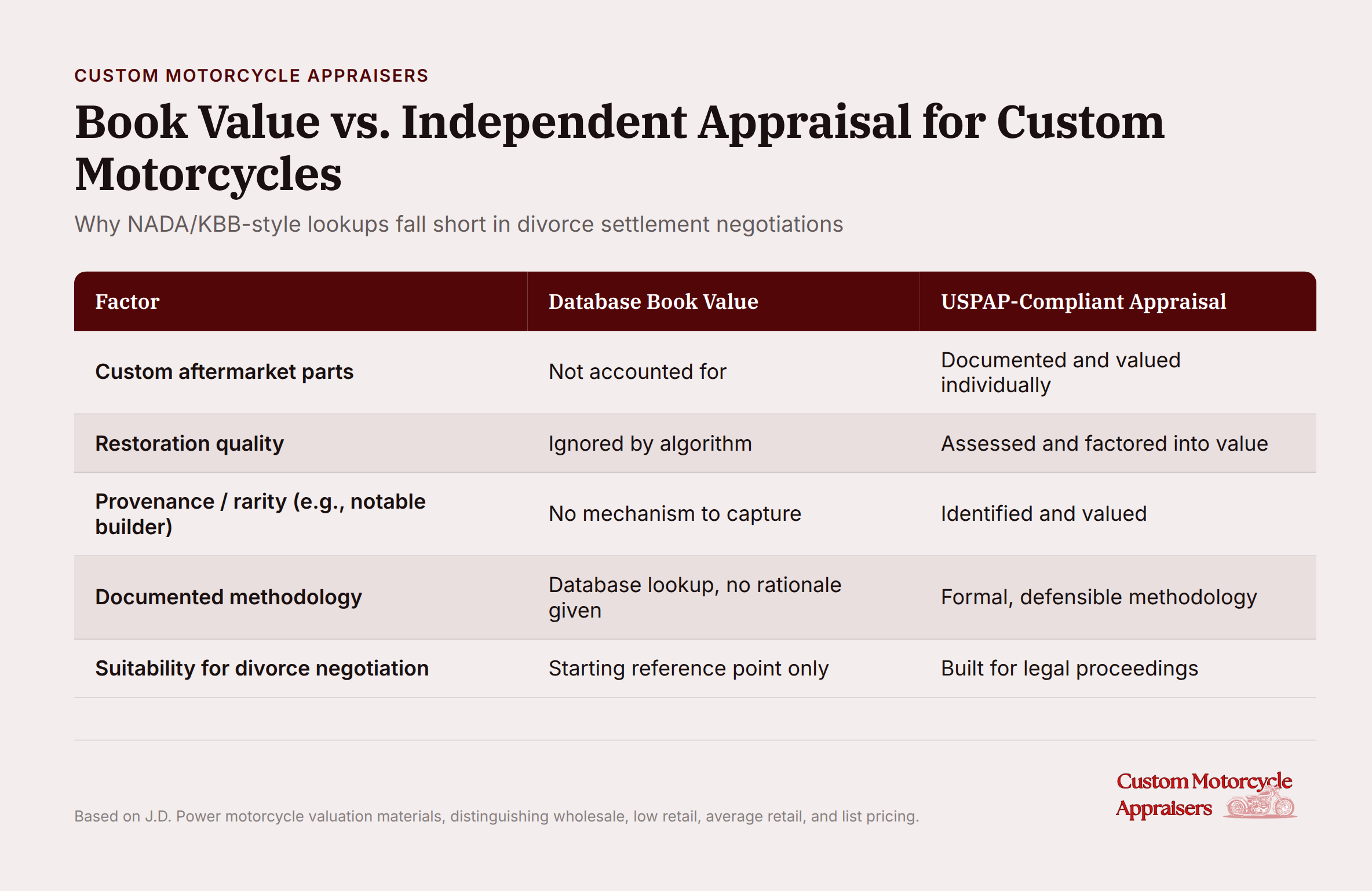
NADA and Kelley Blue Book style guides are built for typical, substantially original motorcycles sold in volume. They work reasonably well for a five-year-old stock cruiser. They fall apart for a bike that has been customized, restored, or kept in unusually low mileage condition, because none of that nuance fits into a database lookup.
These valuation guides generally report a spread of figures, including wholesale or trade-in value, low retail, average retail, and suggested list pricing, and J.D. Power's own motorcycle valuation materials draw that same distinction. A database estimate pulled from one of these tools is useful as a starting reference point, but it is not a substitute for a formal appraisal prepared for a legal proceeding. The tool has no way to account for a documented restoration, a numbers-matching engine, provenance tied to a notable builder, or thousands of dollars in aftermarket parts that a mass-market pricing algorithm was never designed to value.
That gap cuts both ways in a divorce. The spouse who wants to keep the bike has an incentive to point to the lowest book figure available. The spouse giving up an interest in it has an incentive to point to the sticker price of every part ever bolted on. Neither extreme reflects what the motorcycle would actually sell for, and our guide to finding your bike's real value covers why a single database number rarely tells the whole story.
What Value Standard Applies in a Divorce Settlement?
Most states direct courts toward fair market value, defined as the price a willing buyer would pay a willing seller when neither is under pressure to act. Some jurisdictions instead ask for the net value of marital property, meaning value after debts and liens are subtracted, to support an equitable distribution of the whole estate. A smaller number of cases turn on value in use: what the asset is worth to the owner who intends to keep it, rather than what it would fetch on the open market.
Which standard applies is set by the law of the state (or province, in Canada) handling the case, not by the appraiser or either spouse. Because that framework varies by jurisdiction, our appraisers confirm the applicable standard with the client or their attorney before the engagement begins, rather than defaulting to one definition. Getting this wrong produces a technically accurate number that answers the wrong question, which is one of the fastest ways an appraisal loses credibility in a negotiation.
Key takeaway: The value standard, not just the sales data, determines whether an appraisal actually answers what the court or the settlement needs.
How We Value a Custom Motorcycle for Equitable Distribution
The sales comparison approach is the backbone of most motorcycle appraisals. Our appraisers identify recent comparable sales, meaning motorcycles of similar year, make, model, mileage, and condition, then adjust up or down for the specific features of the subject bike.
For a custom build, those adjustments carry most of the analytical weight:
- Aftermarket parts and modifications: documented, quality installations by a reputable builder typically add value; poorly executed or highly idiosyncratic customization can narrow the pool of interested buyers and reduce it.
- Restoration quality: a professionally documented restoration with receipts and before/after photos supports a higher adjustment than an undocumented claim of restoration work.
- Provenance and rarity: a motorcycle tied to a known builder, a limited production run, or a verifiable ownership history commands a premium that a generic valuation guide has no field for.
- Condition and originality: numbers-matching components, original paint, or a well-preserved factory configuration can matter as much as any aftermarket work.
Our guide to valuing custom parts and modifications walks through this adjustment process in more depth, and the same logic applies whether the context is a total loss claim or a divorce settlement: the dollars spent on a modification are not automatically the dollars it adds to resale value.
The Cost Approach: Useful Evidence, Not the Final Word
It's tempting to add up every receipt (purchase price, parts, labor, paint, chrome) and call that the motorcycle's value. That's the cost approach, and it has a real role in a divorce appraisal: it documents what was actually invested and can corroborate other evidence.
But cost is not the same as market value. A $15,000 custom paint and fabrication job might add far less than $15,000 to what a buyer will actually pay, particularly if the styling is unusual or appeals to a narrow audience. Conversely, rare original parts can be worth more on the market than their original purchase price. A credible appraisal uses the cost approach as supporting evidence alongside the sales comparison approach, not as a replacement for it. A report that leans entirely on receipts invites the other side's attorney to ask, reasonably, what a buyer would actually pay.
Why the Valuation Date Changes the Number
Divorce cases don't all use the same date for valuing assets. Depending on the state and the facts of the case, the relevant date might be the date of filing, the date of separation, the date of trial, or another date the court selects. Illinois courts, for example, generally treat property acquired between marriage and the entry of the dissolution judgment as marital property and typically value marital assets as of the judgment date, a framework discussed in the context of a reported Illinois appellate decision. Ohio's marital property framework similarly ties classification to when the property was acquired during the marriage, as addressed in a reported Ohio appellate decision.
Motorcycle values move with market conditions, condition changes, and even the number of miles ridden between separation and trial. An appraisal pegged to the wrong date can understate or overstate the asset's value at the moment the law actually cares about. Our appraisers confirm the governing date with the client's attorney and, where a case has already moved past that date, can provide a retrospective valuation tied to the correct point in time.
How an Independent Appraisal Strengthens Your Negotiating Position
Most divorce property division happens through negotiation, not trial. That makes the appraisal's credibility, not its courtroom admissibility, the thing that actually matters day to day. A soon-to-be-ex-spouse who owns the bike has every incentive to lean on the lowest number a database will produce. A spouse with no stake in the outcome, working from an independent appraiser's report, has a documented, defensible figure to counter that number with.
An independent appraisal carries weight in these conversations for a few concrete reasons:
- No financial interest in the outcome: the appraiser isn't paid more if the value comes in higher or lower, which removes the obvious bias either spouse brings to a self-serving number.
- Documented methodology: a written report shows the comparable sales used, the adjustments made, and the reasoning behind them, rather than a bare assertion of value.
- A defined valuation date and value standard: the report states exactly what question it's answering and when, so it can't be dismissed as answering the wrong one.
- Support for a full equity calculation: the report can be paired with a current loan payoff statement so the negotiation is based on net equity, not gross value.
Attorneys handling motorcycle-related divorce disputes routinely point to this kind of independent documentation as the difference between a stalled negotiation and a settled one, a pattern reflected in practical guidance on motorcycle-related divorce disputes. When both spouses are working from the same credible appraisal, the conversation shifts from arguing about whose number is right to dividing a number both sides accept.
Pro tip: Gather the title, loan payoff statement, purchase and modification receipts, and dated photographs before the appraisal appointment. A complete record shortens the process and gives the appraiser more to work with when documenting condition and provenance.
Credentials to Look For in a Divorce Motorcycle Appraiser
Not every appraiser is equipped to handle a custom or vintage motorcycle correctly. Look for credentials from recognized personal property and vehicle appraisal organizations, such as the American Society of Appraisers (ASA), the International Society of Appraisers (ISA), and the Certified Appraisers Guild of America (CAGA). These organizations set training and ethics standards for the professionals who hold their credentials, and appraisers working under them are expected to follow the Uniform Standards of Professional Appraisal Practice (USPAP), the industry-wide standard published by The Appraisal Foundation.
No single credential guarantees that a particular court or opposing counsel will accept a given report; that decision always rests with the people reviewing it. What a credentialed, USPAP-compliant appraisal does provide is a methodology that can be explained, defended, and compared against a competing valuation on its merits rather than dismissed out of hand.
Settling on a Fair Number, Not a Convenient One
A custom or vintage motorcycle rarely fits neatly into a book value lookup, and in a divorce, that gap becomes someone's leverage unless it gets closed with real evidence. An independent, properly dated appraisal built on actual comparable sales gives both spouses a number they can negotiate around instead of fight over. If a motorcycle is part of your property division and the value is in dispute, our appraisers can prepare an independent, USPAP-compliant valuation scoped to your state's requirements and your case's timeline.
This article is provided for general informational purposes only and does not constitute legal, tax, or financial advice. Readers should consult a qualified attorney regarding the property division laws that apply in their state.