Blog
How to Dispute a Motorcycle Insurance Total Loss Offer That Undervalues Your Custom Bike
Learn how to dispute a motorcycle insurance total loss offer step by step: audit the valuation report, document your custom work, get a USPAP-compliant appraisal, and use the policy's appraisal clause.
An insurer's first total loss offer on a custom motorcycle is often built from stock-bike data, and it can miss thousands of dollars of paint, fabrication, and aftermarket parts. You are allowed to push back, and the owners who do it well treat it as a documentation exercise, not an argument. This guide walks through how to dispute a motorcycle insurance total loss offer: reading the valuation report, proving your custom work, getting an independent appraisal, invoking the appraisal clause, and negotiating from evidence.
Key takeaway: A total loss offer is an opening number based on actual cash value (ACV), and it can be challenged with comparable sales, build documentation, and a USPAP-compliant appraisal.
Why Custom Motorcycle Total Loss Offers Come in Low
Most lowball offers come from a valuation report that treats your bike as a standard production model. The adjuster's software pulls book values and a handful of comparable listings, then applies condition and mileage adjustments. Hand-built or heavily modified bikes do not fit that template, so the custom work gets little credit or none at all.
If you want a deeper look at how parts and modifications are priced in a claim, see our guide on valuing custom parts and modifications in a motorcycle total loss claim. The short version: ACV means what a willing buyer would pay a willing seller for your bike as it existed the day before the loss, and that includes the build.
Step 1: Review the Valuation Report Line by Line
Request the full valuation report in writing and read every line before you respond. You cannot dispute what you have not examined, and the errors are usually specific and fixable.
Check the report for these common problems:
- Wrong model or trim: The year, make, model, or engine size does not match your bike.
- Stock comparables: The comparison bikes are unmodified, so none of your build is reflected.
- Mismatched comparables: The comparisons are from a different region, a different condition tier, or far higher mileage than yours.
- Missing equipment: Custom paint, wheels, exhaust, suspension, and electronics are absent or listed at nominal values.
- Aggressive condition deductions: Pre-loss condition is marked down with no photos or inspection to support it.
- Stale data: Comparable sales or listings are old or unrelated to your current market.
Write down each discrepancy with the report line it came from. This becomes the backbone of your written response.
Step 2: Document Your Custom and Aftermarket Work
Evidence of what was on the bike before the loss is what moves an insurer's number. Gather it all now, because it is easiest to collect before the claim drags on.
Build your file from these sources:
- Receipts and invoices: Parts purchases, paint shop invoices, fabrication and labor bills, and dyno or tuning sheets.
- Build sheets: A written list of every component, brand, and part number, ideally from the builder or shop.
- Photos and video: Pre-loss images from several angles, plus close-ups of paint, engine work, and custom details. Social posts and show photos with dates count.
- Title, registration, and prior insurance paperwork: These confirm identity, year, and any prior agreed or stated value.
- Awards and show records: Evidence of quality that supports a higher condition rating.
Our custom motorcycle appraisal documentation checklist lays out exactly what to pull together and how to organize it. Lost receipts are not fatal. A builder's statement, bank records, and photos can fill gaps.
Pro tip: Receipts show what you spent, not what the work adds to market value. A credible dispute presents both, and does not assume dollar-for-dollar credit.
Step 3: Get an Independent USPAP-Compliant Appraisal
An independent appraisal replaces the insurer's generic number with a supported opinion of value for your specific bike. Our appraisers prepare custom motorcycle appraisals in accordance with USPAP, the Uniform Standards of Professional Appraisal Practice published by The Appraisal Foundation. Our appraisers hold credentials with leading organizations such as CAGA, which is relevant to automobile and vehicle valuation.
A proper appraisal report for a total loss dispute typically includes:
- Identification of the bike and its pre-loss condition, drawn from your documentation
- Selection of comparable sales, adjusted for the custom work, mileage, and condition
- A reconciled conclusion of value with the reasoning shown
- A statement of intended use and the standards followed
On fees, our custom motorcycle appraisals start at $195 for standard reporting, with typical engagements running $195 to $495. Complex builds that need deeper analysis fall higher. Fees are driven by scope, such as the complexity of the build, the completeness of your records, and the depth of analysis required. Every engagement is a fixed fee quoted before work begins, never hourly.
When you are ready, you can request an appraisal and send photos and documents online. No appraiser can promise how an insurer will respond, but a report prepared in accordance with USPAP gives the insurer a defensible, standards-based number to evaluate.
Step 4: Check Your Policy and Invoke the Appraisal Clause
Many policies contain an appraisal clause for disagreements over the amount of loss, and it can be your strongest formal tool. Read your policy wording carefully, because the mechanics vary by insurer and by state.
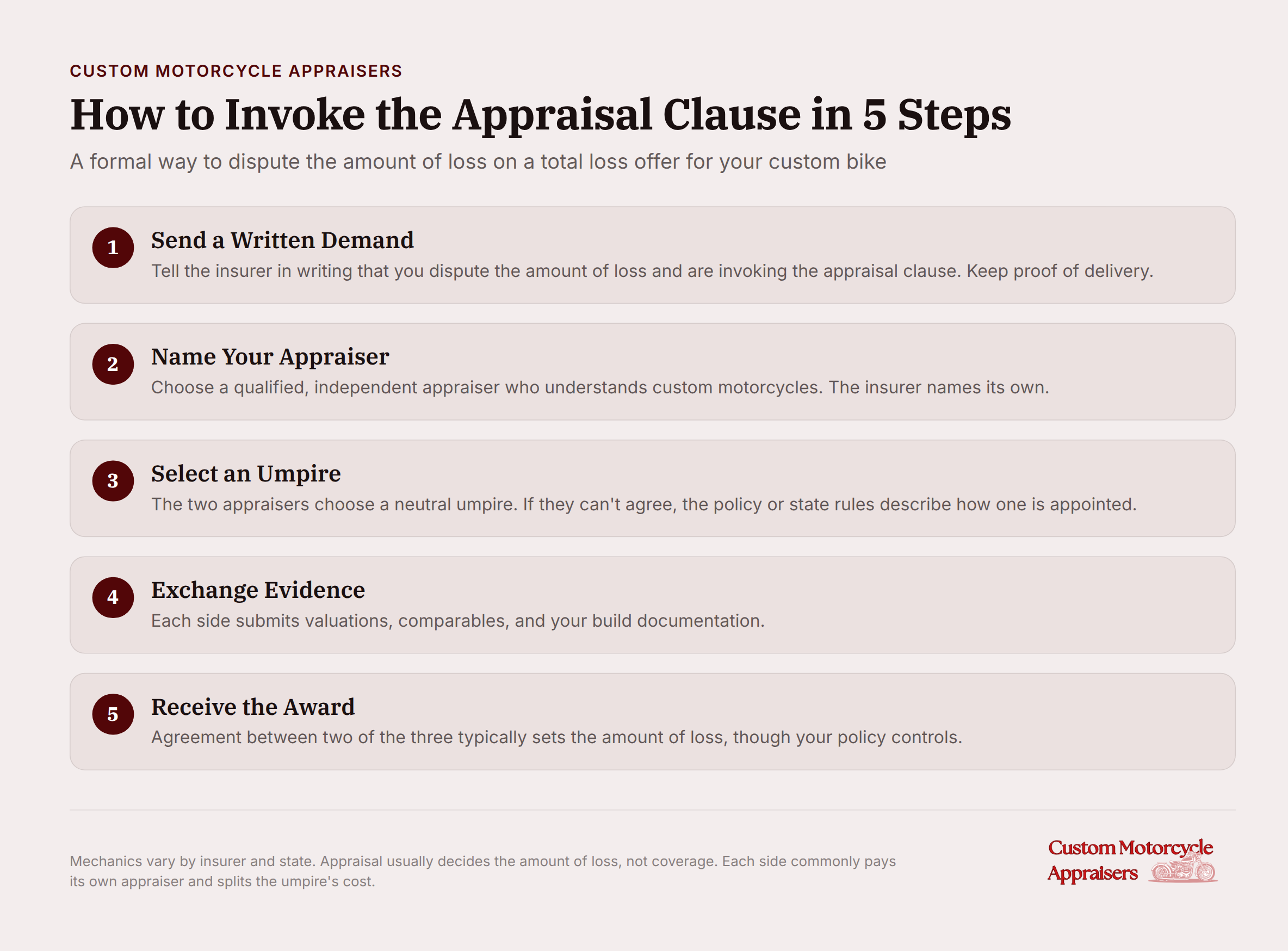
In general terms, the process works like this:
- Send a Written Demand
- Notify the insurer in writing that you dispute the amount of loss and are invoking the appraisal clause. Keep proof of delivery.
- Name Your Appraiser
- You select a qualified, independent appraiser who understands custom motorcycles. The insurer names its own.
- Select an Umpire
- The two appraisers choose a neutral umpire. If they cannot agree, the policy or state rules typically describe how one is appointed.
- Exchange Evidence
- Each side submits valuations, comparables, and your build documentation.
- Receive the Award
- Agreement between two of the three (the two appraisers, or one appraiser and the umpire) typically sets the amount of loss, though your policy controls.
Watch out: The appraisal clause usually decides the amount of loss, not whether the claim is covered. Each side commonly pays its own appraiser and splits the umpire's cost. Confirm the specifics in your policy before you commit.
Step 5: Negotiate With Comparable Documentation
Negotiation works best when you hand the adjuster something easy to act on. Send one organized package, not a stream of emails, and make your request specific.
Your response package should include:
- A short cover letter that states the offered figure, your requested figure, and the reason for the gap
- Your line-by-line list of valuation report errors from Step 1
- Your documentation file from Step 2
- Your independent appraisal report from Step 3
- A reasonable deadline for a written reply, consistent with your policy and state rules
Stay factual and courteous. Do not rely on emotional appeals or threats, and do not accept a verbal revision without it in writing. If the insurer will not move, the appraisal clause in Step 4 is your formal next step, and a complaint to your state insurance department is another avenue to consider.
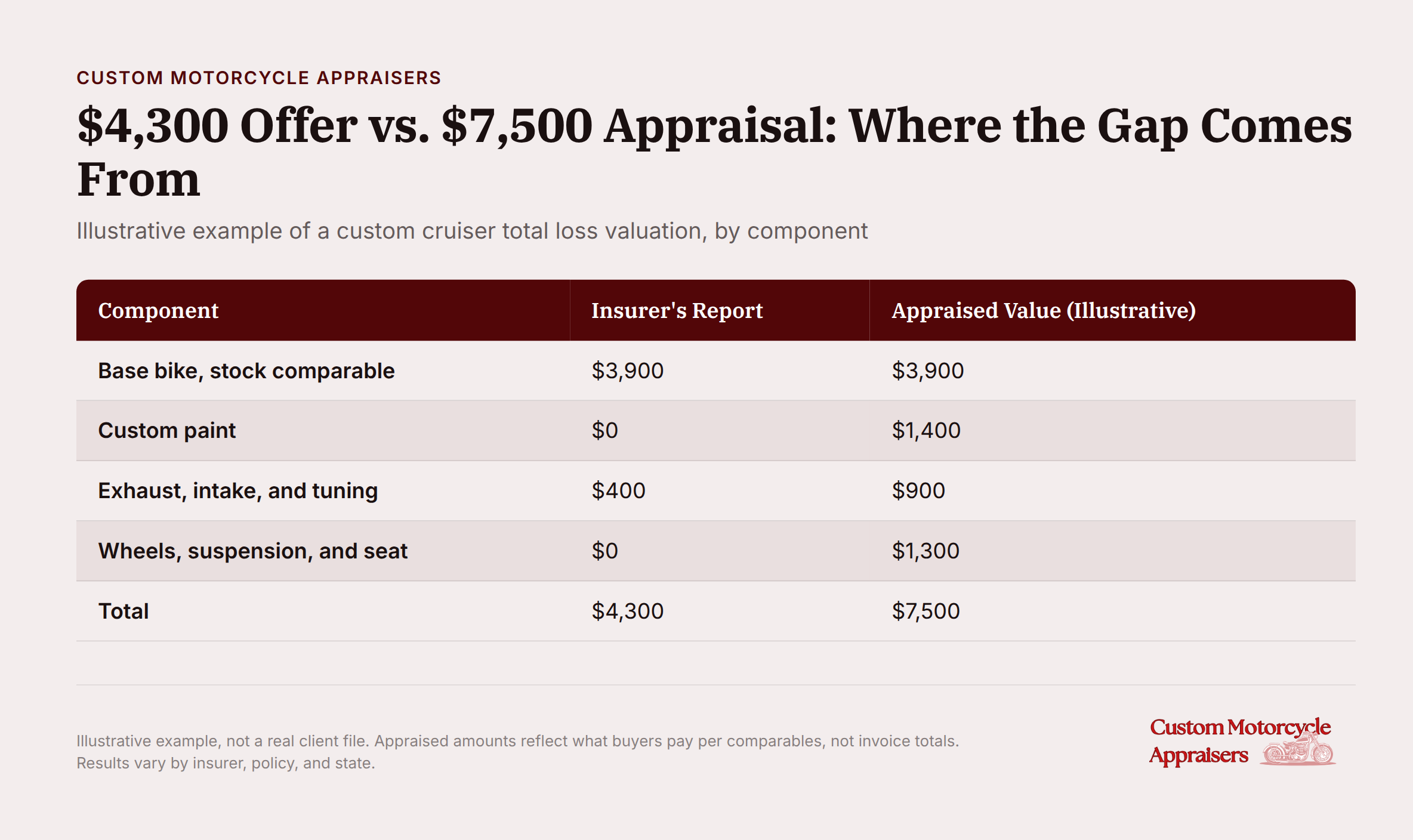
A Worked Example: Disputing a $4,300 Offer
This is an illustrative example, not a real client file. Suppose an owner receives an initial total loss offer of roughly $4,300 on a custom cruiser. The valuation report compares the bike to stock models and credits only a small allowance for the exhaust.
The owner finds the base-bike figure is reasonable, but the report ignores a full custom paint job, upgraded wheels, suspension, and a custom seat, all documented with invoices and photos. An appraisal prepared in accordance with USPAP adjusts comparable sales for each element. The table below shows how that might look.
| Component | Insurer's Report | Appraised Value (Illustrative) |
|---|---|---|
| Base bike, stock comparable | $3,900 | $3,900 |
| Custom paint | $0 | $1,400 |
| Exhaust, intake, and tuning | $400 | $900 |
| Wheels, suspension, and seat | $0 | $1,300 |
| Total | $4,300 | $7,500 |
Notice that the appraised contributions are lower than what the owner spent. Market value credits custom work based on what buyers actually pay, not on the invoice total. That is why the figure is credible: it is supported by comparables, not by the owner's receipts alone.
The owner submits the package and requests a revised offer. If the insurer still refuses to move, the owner can invoke the appraisal clause with the appraisal already in hand. Results vary by insurer, policy, and state, and nothing here is a promise of any outcome.
Protect Your Next Claim Before You Need It
The best time to document a custom bike is before something happens to it. Keeping a current build file and a current appraisal makes any future claim faster to support. Owners of heavily modified bikes may also want to explore agreed value motorcycle insurance, which sets the value in advance instead of leaving it to an ACV calculation after a loss.
If you are facing a lowball offer today, move in this order: audit the report, build the documentation file, get an independent appraisal, then escalate through the appraisal clause if negotiation stalls. Our team prepares fixed-fee custom motorcycle appraisals in accordance with USPAP, and you can start by sending your photos and records through our request an appraisal page.
This article is provided for general informational purposes only and does not constitute legal, tax, or financial advice. Insurance policy terms and state rules vary. Readers should consult a qualified attorney or licensed insurance professional regarding their specific circumstances.