Blog
Do Custom Parts Increase Motorcycle Value, or Hurt Resale Instead?
Most owners assume every dollar spent on custom parts adds a dollar to resale value, but builder and dealer consensus says otherwise. This guide explains which modifications actually support a motorcycle's value and which ones shrink the buyer pool and drag it down.
A chromed-out exhaust, a one-off paint job, or a stretched frame can cost thousands of dollars to build. None of that guarantees the bike is worth more when it sells. Builder forums, dealer trade-in desks, and professional appraisers tend to agree on one point: custom parts rarely return their full installation cost, and some modifications actively shrink the pool of buyers willing to pay close to market value. This guide breaks down why, and how a modified bike actually gets valued.
What the Builder and Resale Community Actually Says
The consensus across riders, dealers, and appraisers is that resale value tracks buyer demand, not receipts. A motorcycle sells for what a comparable buyer will actually pay for it, and that number comes from completed transactions, not from a stack of invoices for parts and labor.
Kelley Blue Book's own motorcycle guidance reflects this. It maintains an optional equipment table for common factory and aftermarket accessories, but it also states plainly that the sheer variety of aftermarket equipment makes it difficult to value accurately without physically inspecting the motorcycle, and that any guidance it does offer is expressed as a percentage of original retail pricing rather than the cost the owner paid to install it (KBB motorcycle valuation FAQ). In practice, that means a $2,000 suspension upgrade does not create a $2,000 resale premium. The real evidence is what similarly modified bikes are actually selling for in the current market.
This is also the lens our team uses when we prepare a custom motorcycle appraisal for insurance, estate, or legal purposes. The goal is a defensible number grounded in market evidence, not a tally of what the owner spent.
Three Lenses for Evaluating Any Modification
Rather than asking "what did this part cost," appraisers and experienced dealers evaluate a modification through three lenses. A mod that scores well on all three is far more likely to support value than one that fails even one.
Installation and Part Quality
Who did the work, and with what parts, matters more than how much it cost. A reputable-brand component installed by a certified technician reads very differently to a buyer (and an appraiser) than the same style of part installed in a home garage.
- Professional installation: Work performed by a certified or dealer-affiliated technician carries documentation and accountability that amateur work lacks.
- Recognized brands: Parts from established manufacturers are easier to verify, source, and service than obscure or no-name aftermarket brands.
- Mechanical integrity: Wiring, fabrication, and structural work that was done to a verifiable standard, rather than improvised, holds up better under inspection.
Mainstream Desirability
A modification only helps resale if enough buyers actually want it. Highly personal styling choices satisfy exactly one buyer: the person who built the bike.
Industry commentary on resale-damaging modifications consistently flags extensive custom paint, stretched or altered geometry, and highly individualized styling as choices that narrow the buyer pool even when they were expensive and well executed (daxstreet's breakdown of mods that hurt resale). A functional accessory like hard luggage or a windscreen appeals broadly. A one-off paint theme or a radically chopped silhouette appeals to a narrow slice of buyers, and everyone else discounts accordingly.
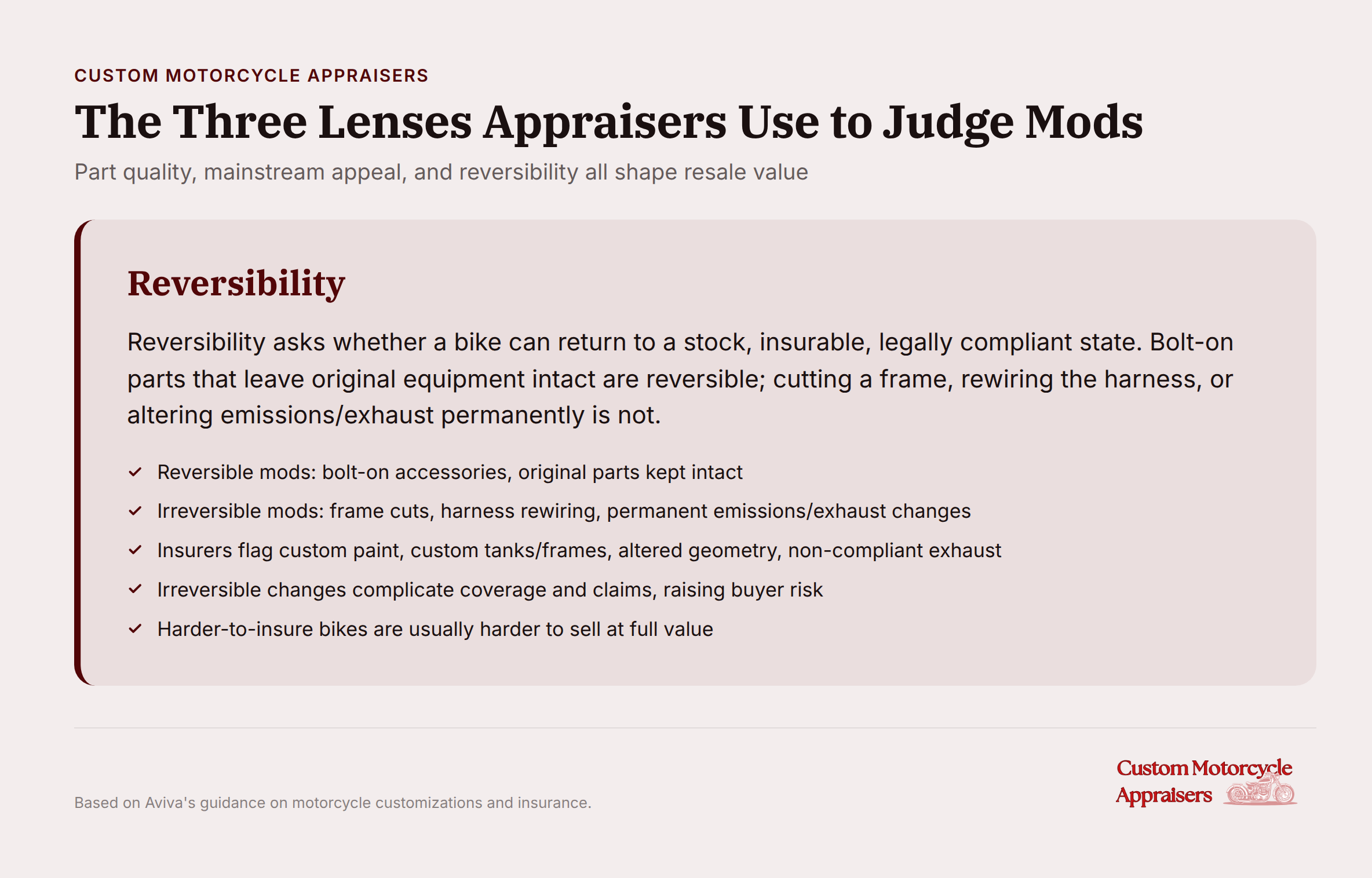
Reversibility
Can the bike be returned to a stock, insurable, legally compliant configuration if a buyer wants that? Bolt-on accessories that leave the original equipment intact are reversible. Cutting a frame, rewiring the harness, or permanently altering emissions and exhaust systems is not.
Modifications that are not reversible carry more risk for the next owner, and buyers price that risk in. The same holds true from an underwriting standpoint: insurers often draw lines around extensive custom paint, custom-built tanks or frames, altered geometry, and non-compliant exhaust or emissions work as factors that complicate coverage and claims (Aviva's guidance on motorcycle customizations and insurance). Whatever makes a bike harder to insure usually makes it harder to sell at full value too.
Which Modifications Tend to Help Resale Value
Modifications are more likely to preserve or modestly support value when they are useful to a wide range of riders, properly installed, and easy to verify.
- Functional touring and protective equipment: Hard luggage, windshields, heated grips, and crash protection appeal broadly because they add usability rather than a personal statement.
- Reputable-brand bolt-on components: Suspension, brakes, or exhaust systems from established manufacturers are easier for a buyer and an appraiser to confirm and price.
- Professional installation with documentation: Dealer or certified-technician installation, backed by receipts and work orders, supports credibility even if it does not guarantee full cost recovery.
- Retained OEM parts: Keeping the original seat, exhaust, bodywork, or wheels in storage lets a buyer revert the bike, which reduces perceived risk.
Which Modifications Tend to Hurt Resale Value
Modifications are more likely to reduce value when they are highly personal, difficult to verify, or hard to reverse. Industry sourcing on custom parts and resale consistently points to the same categories as problematic (research on how custom spare parts affect resale value):
- Extensive custom paint or graphics: A striking paint job built around the owner's personal taste rarely matches what the next buyer wants.
- Chopped frames or structural alterations: Stretched frames, altered geometry, and other structural changes are expensive to build and nearly impossible to undo.
- Amateur wiring or fabrication: Home-built electrical or fabrication work raises reliability and safety questions a buyer cannot easily verify.
- Extreme ergonomics: Forward controls, ape hangers, or seating positions built for one rider's comfort can make the bike unsellable to a broader audience.
- Race or stunt modifications: Components built for track or stunt use often compromise street usability and insurability.
- Noncompliant exhaust or emissions work: Modifications that run afoul of state inspection or emissions rules create legal and registration headaches for the next owner.
- Obscure-brand parts: Components from brands a dealer or appraiser cannot readily verify are difficult to price with confidence.
Comparison: Modification Category and Typical Resale Effect
The table below summarizes how these categories generally play out at resale, based on builder, dealer, and appraisal community consensus rather than any fixed formula.
| Modification Category | Typical Resale Effect | Why |
|---|---|---|
| Reputable-brand bolt-ons (suspension, brakes) | Neutral to modestly positive | Broad appeal, easy to verify, reversible |
| Touring and protective equipment | Neutral to modestly positive | Functional, widely desired by riders |
| Professionally installed work with documentation | Supports credibility | Verifiable, accountable, defensible |
| Retained OEM parts | Supports credibility | Allows reversal to stock configuration |
| Custom paint or graphics | Often negative | Narrow, highly personal appeal |
| Chopped frame or structural change | Often negative | Expensive, irreversible, raises safety questions |
| Amateur wiring or fabrication | Often negative | Unverifiable, reliability concerns |
| Extreme ergonomics | Often negative | Appeals to one rider's preference only |
| Noncompliant exhaust or emissions work | Often negative | Registration and inspection risk |
| Obscure-brand parts | Often negative | Difficult to verify or price |
How Appraisers Actually Calculate a Modified Bike's Value
A competent appraisal does not start by adding up receipts. It starts from the stock baseline value for that make, model, and year, using the same market evidence an appraiser would use for an unmodified motorcycle. From there, the appraiser applies a conservative, evidence-based adjustment for each modification, based on how that specific change performs against the three lenses above: installation quality, mainstream desirability, and reversibility.
This is different from simply totaling what the owner spent. A rebuilt engine and a stretched frame might cost about the same to install, but they will not move the final value by anywhere close to the same amount. The adjustment reflects what the market evidence supports, not what the work cost.
Title status can also overwhelm the effect of any modification entirely. A motorcycle with extensive, high-quality custom work can still be worth substantially less than a comparable clean-title bike if it carries a salvage or rebuilt title, since those designations are known to depress resale value independent of the parts installed (industry guidance on salvage and rebuilt motorcycle discounts).
Key takeaway: Start from stock market value, then adjust conservatively and individually for each modification based on evidence, never by adding up what the owner paid for parts and labor.
Documentation Helps Credibility, Not Cost Recovery
Receipts, installation records, and retained OEM parts matter, but they matter for a different reason than most owners assume. They do not guarantee that a modification adds dollar-for-dollar value. What they do is give an appraiser, an insurer, or a buyer something concrete to evaluate instead of a verbal claim.
A build file checklist that tracks parts, labor, installation dates, and who performed the work turns a subjective story into verifiable evidence. That evidence supports a stronger, more defensible valuation conclusion, even when the underlying modification itself has a neutral or negative effect on resale.
Getting a Defensible Value for a Modified Motorcycle
Owners who built a custom bike understandably want that work recognized. The honest answer is that recognition in a valuation report looks different from recognition in a receipt stack. A qualified appraisal weighs installation quality, mainstream desirability, reversibility, and documentation against real market evidence, then arrives at a number that holds up for insurance, estate, legal, or sale purposes.
If you need a documented, standards-based value for a modified bike, whether for insurance coverage, an estate matter, or a sale, our team can walk through the build with you and produce a report grounded in what the market will actually support.